COVER STORY

Why Middle Managers Hold the Key to Food Safety
This overlooked sub-group plays a large part in determining culture, execution, and risk performance
SCROLL DOWN
Video credit: LumiNola/Vetta via Getty Images
By Lone Jespersen, Ph.D., Founder and Principal, Cultivate SA and Marie Tanner, M.S., retired Quality and Food Safety Executive
Benjamin Franklin believed in "the middling people" as the source of strength for building a new nation.1 The impact of the middle management has since been discussed and experimented with by many. This neglected but critical group is key to an engaged workforce, but is often found to be the least engaged group in the organization.2 This impacts financial performance, with middle manager behaviors accounting for as much as 22 percent of variance in revenue.3
Google's Project Oxygen aimed to eliminate the company's engineering managers, but Google soon realized that managers were crucial for making clear decisions and facilitating collaboration across teams.4 Recent findings have also shown that middle managers rate their organizations' psychological safety lower than both their senior leaders and those at the frontline.5 Finally, 83 percent of supervisors score their food safety culture and psychosocial environment as less mature in comparison to their senior leaders and frontline team members.6 It appears that "middling people" still struggle, and the authors argue that this can be the key reason why some food companies become stuck reacting to food safety instead of moving toward a more predictive and internalized culture.
Despite these learnings, it is still frequently stated that the way to change and sustain a company's organizational culture and its food safety and quality culture "starts at the top" with the most senior leaders—i.e., owners, CEOs, top management teams, and the board of directors. While several cases show that change starts here, the key to unlocking change throughout an organization lies in the power of middle management.
The before-mentioned and prevailing "top-down" approach to change in a food business (e.g., strategy development and deployment, culture changes, and employee engagement) is potentially a thing of the past. In this article, we will explore ways in which a food business can use its organizational structure to improve food safety and quality effectiveness and culture through senior leaders and middle managers. As strategy cycles get shorter,7 the inadequacies in the top-down strategic planning process become more visible. More insights from "day-to-day" work are needed. This is where the importance and power of middle managers becomes visible for setting and translating strategies—including food safety and quality strategy.
Our article draws and integrates findings from social psychology (change and power), organizational management (change, strategy, structure) and risk management (reactive vs. proactive mindsets, business priorities). Through a practical, real-world example case, we will show how food safety and quality effectiveness and culture are impacted by organizational structure and resulting behaviors. The example case will show how a food business changed its food safety and quality effectiveness and culture by changing organizational expectations and driving on-job behavior changes in three sub-groups: senior leaders, middle managers, and the frontline. The company name and product have been anonymized for confidentiality.
"Businesses only change through their members, and successful change will only persist over a long time when individuals alter their on-job behaviors in appropriate ways."


System Implementation vs. On-Job Behavior Changes
Food safety systems can be developed and implemented to pass a third-party audit but fail to keep consumers safe and satisfied. This can happen when individuals have not altered their on-job behaviors, as shown in our example case below and through real-world recalls in 2024 and 2025 at Boar's Head, PepsiCo, TreeHouse, and Hormel. All had passed third-party audits while sending unsafe products into the market.
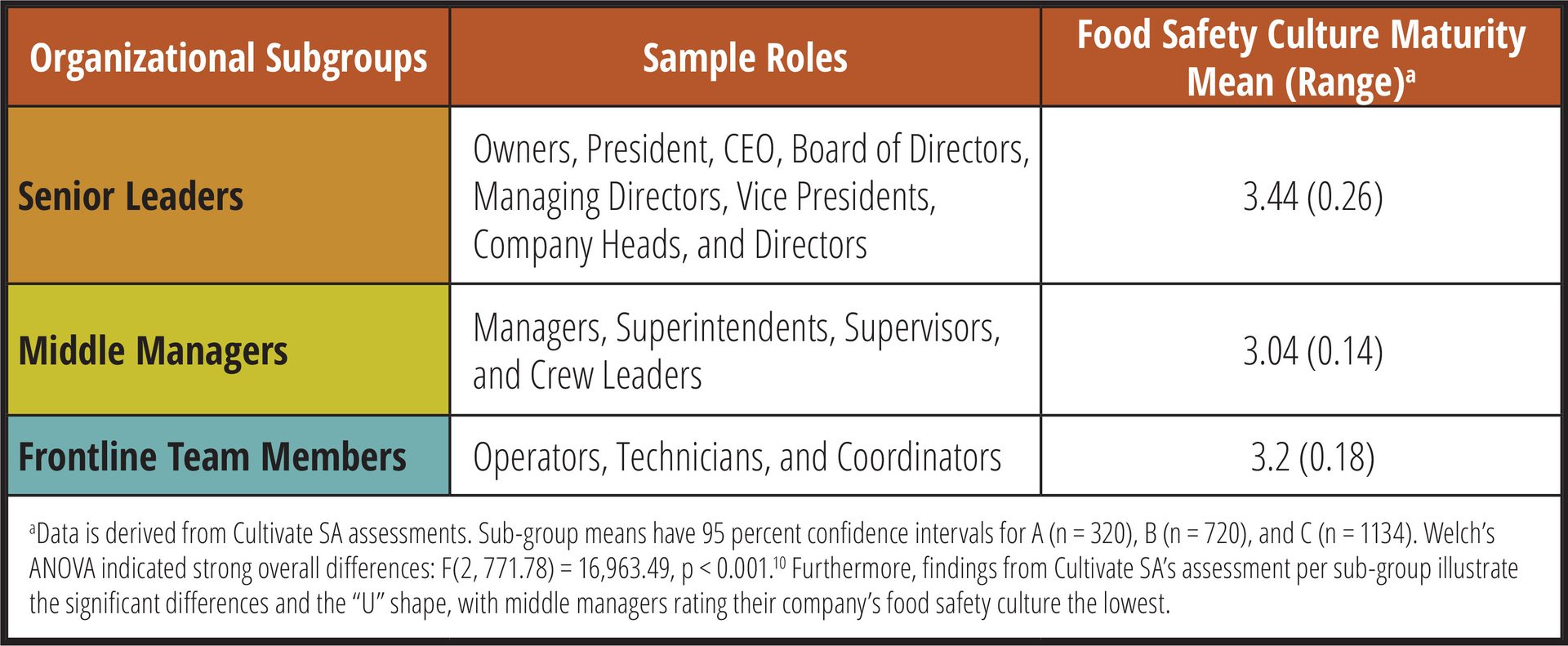
Systems do not on their own secure consumers or improve food safety and quality effectiveness or culture. Businesses only change through their members, and successful change will only persist over a long time when individuals alter their on-job behaviors in appropriate ways.8 The term "food safety and quality effectiveness" draws on learnings from thought leaders such as Daniel R. Denison,9 who have shown that organizational effectiveness is only possible through adapting altered on-job behaviors (Table 1).
TABLE 1. Framework to connect organizational structure, sub-groups, and sample roles in food businesses (Image credit: Cultivate SA)
Practical, Real-World Case: TomatoPure, 2023
"TomatoPure" is an anonymized consumer packaged goods company used as a representative case study. It highlights typical challenges faced in the food manufacturing sector, with all identifying details removed.
TomatoPure is a northern Italy-based success story. Founded by an entrepreneur committed to producing natural, high-quality tomato paste and sauces, the brand expanded rapidly and became a staple for retailers and food manufacturers across Europe.
Following TomatoPure's acquisition by GlobalPantry Foods, the external food safety landscape began shifting rapidly. Between 2022 and 2024, several high-profile sauce recalls raised public concern and tightened regulatory expectations worldwide. For example, in June 2024, Hudson Harvest issued a voluntary recall of its Tomato Basil Sauce due to swelling, leaking, and bursting jars linked to possible under-processing, potentially allowing spoilage organisms or pathogenic bacteria to proliferate. The U.S. Food and Drug Administration (FDA) noted that such spoilage can allow pathogens like Clostridium perfringens and Bacillus cereus to grow, presenting serious food safety risks. U.S. authorities classified the product as a Class II recall, signaling elevated health concerns if consumed.
These industry events further heightened expectations among regulators, retailers, and consumers, reinforcing the need for robust food safety culture and systems.
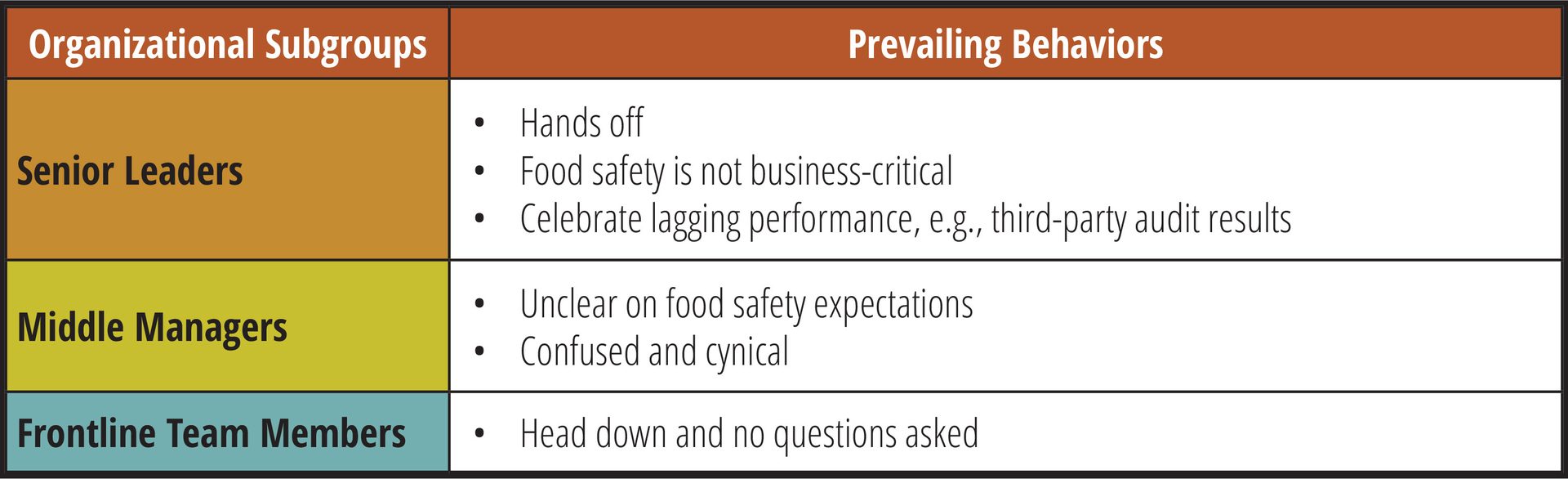
Within GlobalPantry, everyone understood the environment was changing. A company-wide food safety culture assessment revealed entrenched and problematic behaviors across TomatoPure operations in 2023 (Table 2).
TABLE 2. TomatoPure prevailing behaviors by subgroup, 2023 (Image credit: Cultivate SA)
While the CEO acknowledged the need for change, their primary focus remained on supply chain volatility and margin pressure. The pandemic forced a strategic shift toward resilience and profit defense, which led senior leaders and middle managers to delegate responsibility for food safety culture improvement to the head of food safety and quality.
The director of quality systems led a detailed assessment and action plan, revealing several cultural obstacles regarding the prevailing culture at TomatoPure:
- Food safety ownership was confined to the quality silo, with other functions disengaged
- The senior site manager questioned the need to participate in the assessment, saying, "Food safety isn't really part of my responsibilities"
- The manufacturing team was focused on commissioning new lines, and although the plant manager used the right terminology, day-to-day behavior contradicted stated commitments
- Middle managers expressed cynicism due to vague expectations, often stating, "No one cares what works or what we think"
- Frontline employees believed food safety was someone else's job and avoided raising issues.
The 2023 food safety culture assessment produced an average score of 2.1 (on a scale where 1 = weak and 5 = strong).
Changing Impact of Senior Leaders on Middle Management
Tucker, Ehr, and Ogunfowora11 show that food safety behaviors at the frontline are most effectively influenced by those reporting to a CEO (i.e., most senior leader), rather than being influenced by the CEO or the supervisors (i.e., middle managers). This "trickle-down effect" is important, but it has been shown in areas like sustainability that a "middle-up-down" approach12 is likely even more impactful. The "middle-up-down" approach helps ensure the iterative process of integrating and coordinating top-down information with information on the business environment at the middle manager level.13 Strategic implementation encompasses the managerial interventions that align organizational actions with strategic intention.14
"It is essential to develop a high-power mindset in middle managers to minimize the risk of stress, burnout, and lack of retention, which can happen if more ownership is expected without acknowledging the time and effort this requires from each middle manager."
The impact of a disengaged middle management can be seen in self-interested interventions including delaying strategy implementation, subversive behaviors such as coalition formation, or deliberate creation of barriers to implementation.15 CEOs, the C-suit, and senior leaders must ensure shared beliefs between themselves and middle managers to avoid wasted effort in strategy implementation. Most strategies are designed with change in mind, and the action commitment (i.e., communication, interpretation, enactment) of resource allocation and other activities necessary for strategic implementation are critical for both senior leaders and middle management. An "action commitment" can be an important antecedent of behavior and relates to middle managers' readiness or intention to perform a given on-job behavior.16
Changing Power of Middle Management in Food Safety
Middle managers are mid-level professionals working above the lower level of operational employees but below top management.17 Wooldridge et al. defines middle managers as "functional-level line managers who hold intermediate positions within the organizations."18 Their distinguishing feature is their access to top management coupled with their knowledge of operations. They act as coordinators for day-to-day activities—for example, managers and supervisors in production, procurement, food safety, human resources, maintenance, and product development.
This level is traditionally handed the strategies in a food business and expected to act as "good soldiers" without meaningful involvement to implement.19 This has led to some predictably poor outcomes and frustration, and is likely linked to Kotter's statistic of 70 percent failure of change initiatives to deliver expected results.20
Middle managers obviously bring value, as they are accountable for day-to-day food safety actions and know what works and what does not. However, middle managers need to sell their views and ideas to have a seat at the strategic table and subsequently influence implementation. Involvement of middle managers does not simply happen; managers must work at it to make it happen.21
The risk of a disengaged middle management can signal the development of "organizational change cynicism."22,23 This disengagement can lead to failure to conform to role-based expectations, as well as social conflicts and confusion. For this reason, it is important to rewrite and clarify if expectations around interpersonal relationships are changing. A company should invest in its middle managers to help their proficiency in task shifting, specifically when power shifts; this requires a different mindset to minimize "mood spillover." It is essential to develop a high-power mindset in middle managers to minimize the risk of stress,24 burnout, and lack of retention, which can happen if more ownership is expected without acknowledging the time and effort this requires from each middle manager.
Practical, Real-World Case: TomatoPure, 2025
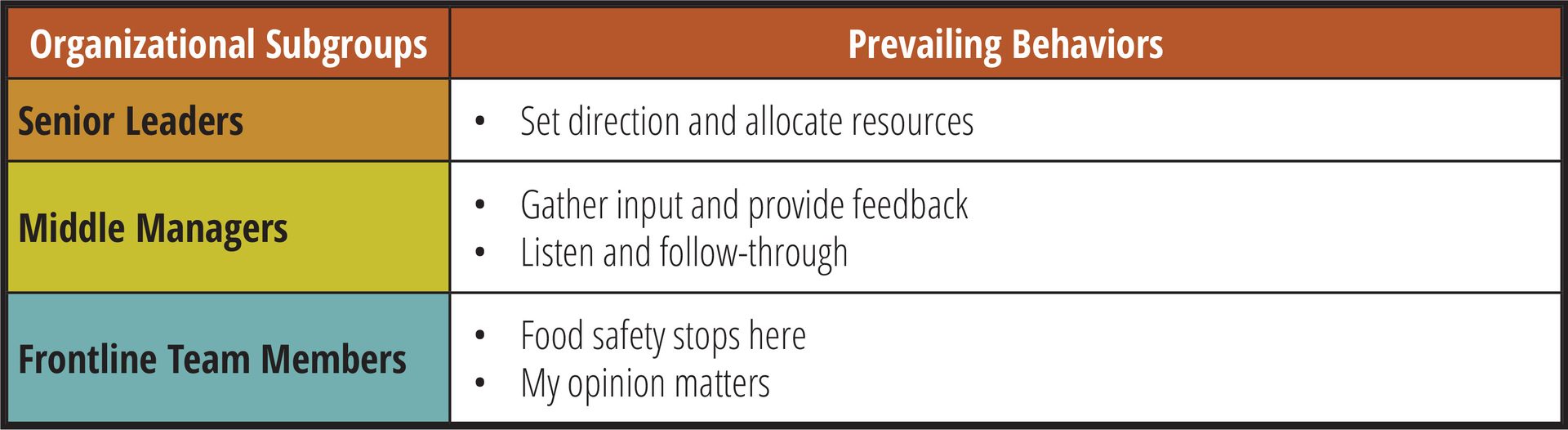
A second assessment in 2025, two years after the acquisition, revealed substantial behavioral improvements across TomatoPure (Table 3).
TABLE 3. TomatoPure prevailing behaviors by subgroup, 2025 (Image credit: Cultivate SA)
Between 2024 and 2025, the external food safety landscape intensified. In 2024, Hudson Harvest recalled its Tomato Basil Sauce when jars were found swollen or leaking due to under-processing, raising concerns of spoilage and potential pathogen growth. In late 2025, another widely publicized recall involved multiple tomato sauces from First and Last Bakery due to improper heat processing that could allow Clostridium botulinum toxin formation. FDA warned that failures in processing acidified foods like tomato sauces can enable Clostridium botulinum growth, posing the risk of illness or death and prompting urgent guidance for consumers to discard or return the products.
These incidents reinforced to GlobalPantry's leadership that food safety culture must be strengthened from within, not just through technical controls. During this same period, GlobalPantry's CEO refreshed much of the senior leadership team, and the new head of operations appointed a new plant manager for TomatoPure. Rather than relying on external certification, GlobalPantry committed to building internal capability and cross-functional ownership of food safety.
A Transformed Culture at TomatoPure
The new TomatoPure plant manager moved quickly and deliberately:
- All functional silos were dismantled
- Clear expectations were defined and reinforced through regular one-on-one accountability sessions with each leader
- Team-based dialogue complemented individual sessions to build alignment and shared ownership.
A new operating cadence—quarterly, monthly, weekly, and daily meetings—was institutionalized. Each meeting had a standard agenda, an open discussion environment, and strict follow-through. Food safety and worker safety were at the top of every agenda.
New Focus: Cross-Functional Internal Audits and Gemba Walks
Instead of pursuing only external certification, TomatoPure and GlobalPantry introduced a company-wide commitment to cross-functional internal audits and recurring Gemba walks:
- Internal audits were redesigned to be cross-functional, pairing roles that normally would not work together
- Gemba walks became mandatory and recurring, with leaders physically present on the production floor, observing processes, asking questions, and learning from operators
Walks were intentionally paired across roles and functions:
- Vice president of human resources walking Line 1 with a warehouse supervisor
- Finance director paired with a maintenance lead
- Sales manager walking the packaging line with a quality technician.
This pairing design served three cultural goals:
- Break down silos by exposing leaders to operational realities
- Build shared ownership of food safety across all functions
- Create psychological safety and open dialogue between different levels of the organization.
The head of operations emphasized that food safety is no longer a quality-only responsibility but a collective behavioral system, reinforced through seeing, learning, and acting together on the Gemba walks.
HACCP and Capability Development
The HACCP team was completely rebuilt:
- Leaders no longer "attended"; they actively contributed and demonstrated ownership of hazards within their functional areas
- A proficiency assessment was administered to all HACCP team members
- Customized learning tools were deployed to close TomatoPure-specific competency gaps.
Frontline Engagement
By 2025, frontline employees increasingly saw themselves as essential contributors to consumer protection and TomatoPure's success. Many described themselves as the last line of defense for food safety. Importantly, they now believed that:
- Their managers would listen when food safety concerns were raised
- Senior leaders would help solve problems, rather than assign blame.
"Cross-functional Gemba walks, redesigned internal audits, and collective ownership of HACCP created the conditions for engagement, alignment, and accountability across all levels of the company."
Actions for Tomorrow
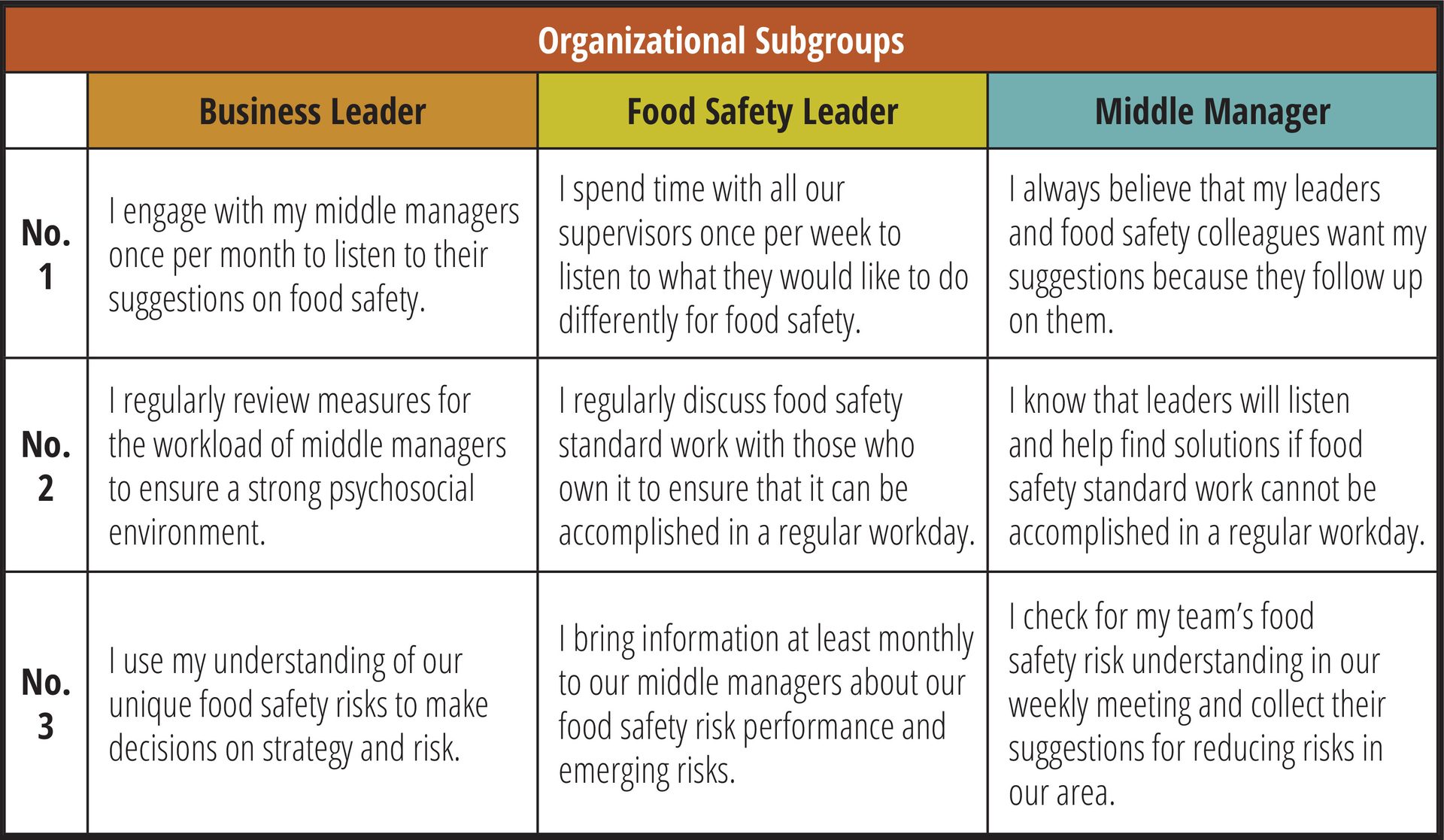
As this case history has demonstrated, company and organizational structure and assumptions can impact food safety effectiveness. Based on the learnings presented here, we suggest that business leaders, food safety and quality leaders, and middle managers ask the questions in Table 4 to evaluate if the middle managers are set up for success. If "yes" is the answer to all statements, congratulations—your company is well on the way to an internalized culture. If "no" is the answer to one or more statements per organizational subgroup, then there is more work to be done.
TABLE 4. Questions to help unleash the power of middle managers (Image credit: Cultivate SA)
Practical Tools for Identifying and Evaluating Risk Accurately
- Risk Matrix or Heat Map
Visually plots the probability (likelihood) of an event against its severity (impact). Helps prioritize risks across facilities, systems, or processes. - Failure Mode and Effects Analysis (FMEA)
Systematically evaluates where and how processes could fail, and the consequences if they do. Assigns numerical scores for occurrence, severity, and detection to calculate a risk priority number (RPN). - Historical Incident Data and Complaint Trends
Using actual plant-level or industry-wide data on past recalls, deviations, and consumer complaints can reveal systemic weak points and predict future risk areas. - Environmental Monitoring and Sanitation Validation Data
Provides real-time risk indicators, especially for microbial and allergenic threats, which can be tied to operational decisions (e.g., infrastructure upgrades, cleaning frequencies). - Near-Miss and CAPA Tracking
Formalizes tracking of how near-misses are logged and investigated, while CAPA tracking can expose underestimated or recurring risks that have not yet resulted in a failure, but could. - Insurance Risk Assessments and Underwriter Feedback
Leverage insurer-provided assessments and audit services. These often offer third-party validation of risk exposure from a financial and liability standpoint. - Competitive Failure Benchmarking
Evaluate public recall data and case studies from companies in your category. Understanding how peers have failed—and what it cost them—adds context and credibility to internal ROI arguments.
Takeaway
The experiences highlighted in this article reinforce a powerful and often underestimated truth: middle managers sit at the fulcrum of food safety culture. While senior leaders set direction and expectations and frontline teams execute daily tasks, it is middle managers who translate intent into on-job behaviors. These behaviors ultimately determine whether a food business reacts to food safety risks or prevents them. Across industries and in the TomatoPure case, weak clarity, inconsistent expectations, and limited cross-functional ownership consistently left middle managers under-supported, disengaged, and unable to influence meaningful change.
Yet, when organizational structures, leadership behaviors, and daily routines are intentionally redesigned, middle managers become catalysts for internalized food safety culture. The transformation at TomatoPure demonstrates that when senior leaders anchor food safety as a business priority, when middle managers are equipped with clear expectations and authority, and when frontline employees feel psychologically safe to speak up, cultural and behavioral change accelerates rapidly. Cross-functional Gemba walks, redesigned internal audits, and collective ownership of HACCP created the conditions for engagement, alignment, and accountability across all levels of the company.
Looking ahead, food businesses must confront the reality that increasing expectations without redesigning support systems leads to burnout, cynicism, and operational blind spots. A mature food safety culture is not built through technical systems alone; it emerges through people who feel heard, empowered, and responsible. By reevaluating structural assumptions, strengthening psychosocial environments, and integrating middle managers more deliberately into strategy, food companies can build resilient cultures capable of anticipating risks, protecting consumers, and enabling long-term success. The path to predictive, internalized food safety culture runs straight through the middle, and investing in this group is not optional but essential.
Funding Acknowledgment Statement
This article was supported by the U.S. Food and Drug Administration (FDA) of the U.S. Department of Health and Human Services (HHS) as part of a financial assistance award (FAIN) totaling $500,000, with 100 percent of this article funded by FDA/HHS. The contents are those of the authors and do not necessarily represent the official views of, nor an endorsement by, FDA/HHS or the U.S. government.
References
- Isaacson, W. Benjamin Franklin: An American Life. Simon & Schuster, 2004.
- Caye, J.-M., R. Strack, P. Orlander, et al. "Creating a New Deal for Middle Managers: Empowering a Neglected but Critical Group." Boston Consulting Group and World Federation of People Management Associations. July 2010. https://www.eapm.org/wp-content/uploads/2014/05/BCG-Creating-a-New-Deal-for-Middle-Managers-Jul-10.pdf.
- Mollick, E. "Why Middle Managers Might Be the Most Important People in Your Company." May 25, 2011. Knowledge at Wharton Podcast. https://knowledge.wharton.upenn.edu/podcast/knowledge-at-wharton-podcast/why-middle-managers-may-be-the-most-important-people-in-your-company/.
- Garvin, D.A., A. Berkley Wagonfeld, and L. Kind. "Google's Project Oxygen: Do Managers Matter?" Harvard Business School Case Collection. October 2013. https://www.hbs.edu/faculty/Pages/item.aspx?num=44657.
- Hagen, J.U. and B. Zhao. "Middle Managers Feel the Least Psychosocial Safety at Work." Harvard Business Review. October 22, 2025. https://hbr.org/2025/10/middle-managers-feel-the-least-psychological-safety-at-work.
- Cultivate SA. "Food Safety Culture Assessment Data 2015–2025." 2026.
- Hamel, G. Leading the Revolution: How to Thrive in Turbulent Times by Making Innovation a Way of Life. Harvard Business School Press, 2000.
- Choi, M. "Employees' Attitudes Toward Organizational Change: A Literature Review." Human Resource Management 50, no. 4 (July 2011): 479–500. https://doi.org/10.1002/hrm.20434.
- Denison, D.R. Corporate Culture and Organizational Effectiveness. 2nd Ed. Denison Consulting, May 1997.
- Cultivate SA. "Broken At the Core: Enabling Your Middling People to Own Food Safety." Publication in progress.
- Tucker, S., B. Ogunfowora, B., and D. Ehr. "Safety in the C-Suite: How Chief Executive Officers Influence Organizational Safety Climate and Employee Injuries." Journal of Applied Psychology 101, no. 9 (2016): 1228–1239. https://psycnet.apa.org/fulltext/2016-28694-001.html.
- Nonaka, I. "A Dynamic Theory of Organizational Knowledge Creation." Organization Science 5, no. 1 (February 1994): 14–37. https://www.jstor.org/stable/2635068.
- Posch, A. and G. Speckbacher. "The Role of Middle Management in the Implementation of Sustainabilty Strategies." Academy of Managament. November 30, 2017. https://journals.aom.org/doi/10.5465/ambpp.2016.15505abstract.
- Floyd, S.W. and B. Wooldridge. "Managing Strategic Consensus: The Foundation of Effective Implementation." The Executive 6, no. 4 (November 1992): 27–39. https://www.jstor.org/stable/4165092.
- Floyd, S.W. and P.J. Lane. "Strategizing Throughout the Organization: Managing Role Conflict in Strategic Renewal." The Academy of Management Review 25, no. 1 (2000): 154–177. https://doi.org/10.2307/259268.
- Ajzen, I. "The Theory of Planned Behaviour: Reactions and Reflections." Psychology & Health 26, no. 9 (2011): 1113–1127. https://doi.org/10.1080/08870446.2011.613995.
- Mintzberg, H. Structure in Fives: Designing Effective Organizations. Prentice-Hall, 1983.
- Wooldridge, B., T. Schmid, and S.W. Floyd. "The Middle Management Perspective on Strategy Process: Contributions, Synthesis, and Future Research." Journal of Management 34, no. 6 (2008): 1190–1221. https://doi.org/10.1177/0149206308324326.
- Hart, S.L. "An Integrative Framework for Strategy-Making Process. The Academy of Management Review 17, no. 2 (1992): 327–351. https://doi.org/10.2307/258775.
- Kotter, J.P. and J.L. Heskett. Corporate Culture and Performance. The Free Press, 1992.
- O'Shannassy, T. "Investigating the Role of Middle Managers in Strategy-Making Process: An Australian Mixed Method Study." Journal of Management & Organization 20, no. 2 (March 2014): 187–205. https://doi.org/10.1017/jmo.2014.29.
- Balogun, J. "From Blaming the Middle to Harnessing Potential: Creating Change Intermediaries." British Journal of Management 14, no. 1 (March 2003): 69–83. https://onlinelibrary.wiley.com/doi/10.1111/1467-8551.00266.
- Brown, M. and C. Cregan. "Organizational Change Cynicism: The Role of Employee Involvement." Human Resource Management 47, no. 4 (Winter 2008): 667–686. https://doi.org/10.1002/hrm.20239.
- Gavett, G. and V. Sawhney. "What's the Future of Middle Management?" Harvard Business Review. April 29, 2025. https://hbr.org/2025/04/whats-the-future-of-middle-management.
Lone Jespersen, Ph.D. is a published author, speaker, and the Principal and Founder of Cultivate SA, a Switzerland-based organization dedicated to eradicating foodborne illness, one culture at a time. Dr. Jespersen has worked with improving food safety through organizational culture improvements for 20 years, since she started at Maple Leaf Foods in 2004. She chaired the Global Food Safety Initiative (GFSI) technical working group A Culture of Food Safety, chaired the International Association of Food Protection (IAFP) professional development group Food Safety Culture, and was the technical author on the BSI PAS320 Practical Guide to Food Safety Culture.
Dr. Jespersen holds a Ph.D. in Culture Enabled Food Safety from the University of Guelph in Canada and a master's degree in Mechanical Engineering from Syd Dansk University in Denmark. Dr. Jespersen serves as Chair of the IFPTI board and as Director on the Stop Foodborne Illness board. She is also a member of the Editorial Advisory Board of Food Safety Magazine and a member of the Educational Advisory Board of the Food Safety Summit.
Marie Tanner, M.S. is a recently retired executive with over 35 years of global leadership in quality and food safety. She has served as Senior Vice President of Global Quality at Reckitt, Senior Vice President of Quality and Food Safety at DFA, and Global Chief Food Safety and QHSE Officer at Kerry. Earlier in her career, she held progressive quality leadership roles at PepsiCo and Godiva.
Marie holds an M.S. degree in Food Science from Rutgers University and has contributed her expertise as a former board member for SSAFE, a global nonprofit working to integrate food safety, animal health, and plant health across supply chains.