30th Anniversary Retrospective

A Look Back at the History of HACCP Validation and Verification Guidance
SCROLL
DOWN
Welcome to the sixth and final Anniversary Retrospective for Food Safety Magazine's 30-year anniversary! In these columns, I've been examining trends in food safety science and regulation from the present day vs. the mid-1990s, when FSM entered the scene as Food Testing & Analysis.1–5
In the October/November issue, we looked back at regulatory approaches to pesticide residues in foods, including how the U.S. Food and Drug Administration (FDA) and the U.S. Department of Agriculture (USDA) test for and measure pesticide residues, as well as the MAHA Commission's apparent relaxation on the topic.5
In this month's Retrospective, we'll take a look at the evolution of Hazard Analysis and Critical Control Points (HACCP) plan validation and verification for USDA Food Safety and Inspection Service (FSIS)-regulated products, which was a topic of concern and development in the mid-1990s and remains a dynamic focus today.
HACCP Validation and Verification, From 1995 to Today
In the December 1995/January 1996 issue of Food Testing & Analysis, the former Director of FSIS' Chemistry Division, Richard L. Ellis, Ph.D., contributed a lengthy article on the regulatory analysis of meat and poultry products (Figure 1).6 In his article, Dr. Ellis discussed the implications of regulatory requirements on analytical testing methods for chemical analyses, environmental contaminants including pathogens, pesticide residues, and veterinary drug residues.
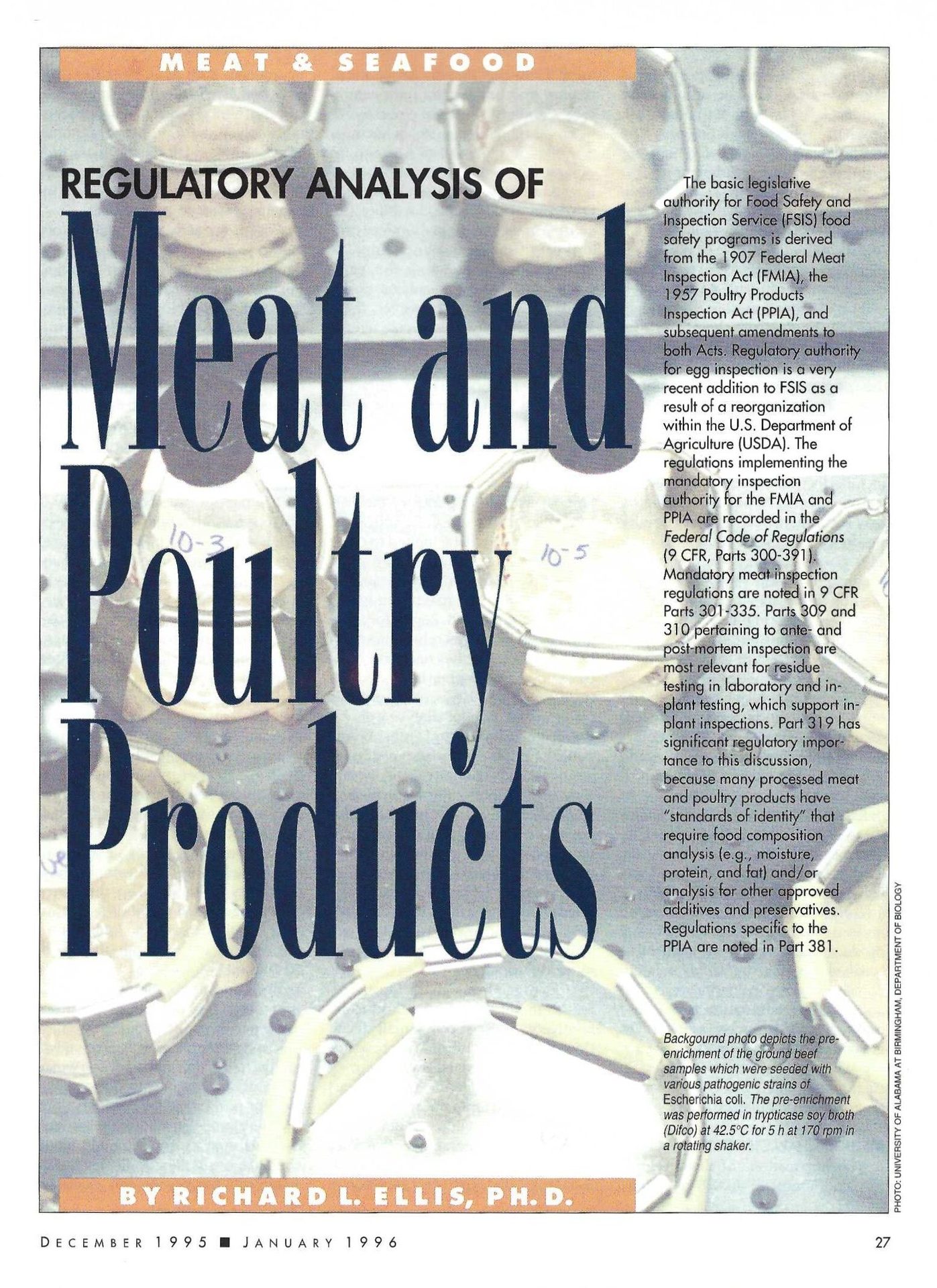
FIGURE 1. "Regulatory Analysis of Meat and Poultry Products" by Richard L. Ellis, Ph.D. from Food Testing & Analysis, December 1995/January 1996 (Credit: Food Safety Magazine)
In his concluding section (Figure 2) on developments for testing methods and programs, Dr. Ellis noted that changes were on the horizon for food safety testing:
The food safety regulatory climate shows a clear indication of instituting more HACCP programs… Recently, FSIS proposed a HACCP system for meat and poultry inspection, which includes six key issues: HACCP plan approval, training/certification, phase-in, measures of effectiveness, compliance/enforcement, and the relationship and effect of HACCP with current inspection procedures.
Dr. Ellis further stressed the need for ongoing HACCP verification by FSIS inspectors:
It will be necessary to determine—on a continuing basis—that HACCP plans are working effectively, and to identify the best ways to ensure compliance with HACCP models… The advent of both environmental and HACCP inspection programs indicates change—perhaps rapid change—in methods development and laboratory analysis.
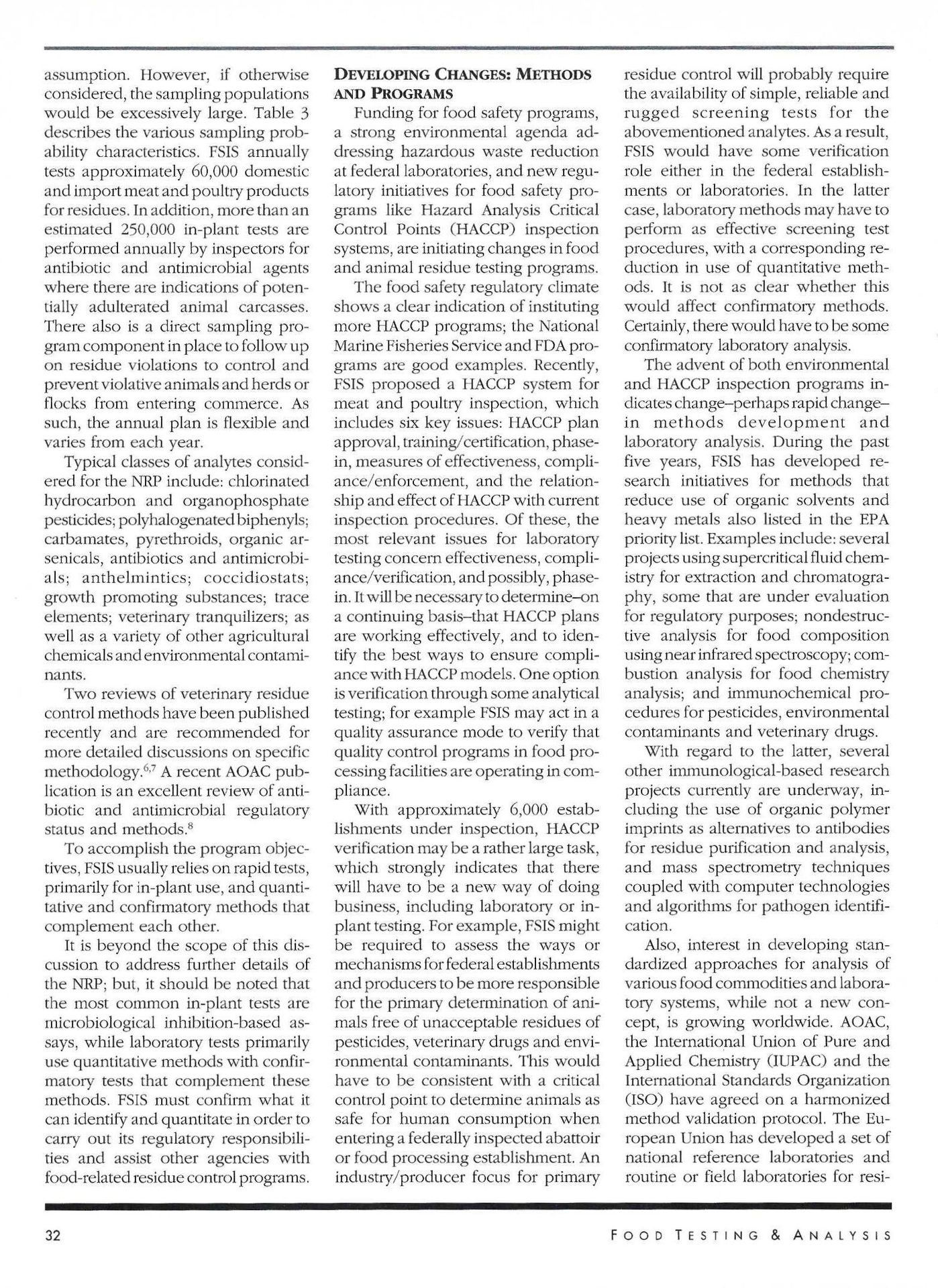
FIGURE 2. "Regulatory Analysis of Meat and Poultry Products" by Richard L. Ellis, Ph.D. from Food Testing & Analysis, December 1995/January 1996 (Credit: Food Safety Magazine)
USDA-FSIS followed through on its proposed adoption of HACCP systems, issuing regulations in July 1996—just months after Dr. Ellis' article was published—requiring federally inspected establishments to adopt HACCP systems.7 One of the tenets of the regulation is the requirement that "establishments validate the HACCP plan's adequacy to control the food safety hazards identified by the hazard analysis… [and] conduct activities designed to determine that the HACCP plan is functioning as intended,"8 i.e., verification.
To aid industry in this effort, FSIS introduced an initial draft guidance in March 2010 describing compliance with requirements for HACCP systems, pursuant to the "Validation, Verification, Reassessment" section (§417.4) of the July 1996 Pathogen Reduction; Hazard Analysis and Critical Control Point (HACCP) Systems regulations. The draft guidance was revised and reissued in May 2013,9 after FSIS reviewed and incorporated the comments received on the initial draft. The proposal was then formalized in April 2015 with the issuance of a final guidance.10
FSM Editorial Advisory Board member and longtime contributor John Surak, Ph.D. explained key differences in the terms used in the 2013 draft guidance in an August 2014 article on validation, verification, and monitoring. Dr. Surak wrote, "USDA uses the terms 'HACCP plan' and 'HACCP system.' The HACCP system is defined as 'the HACCP plan in operation, including the HACCP plan itself.' In addition, the HACCP system includes the HACCP plan, all supporting documentation, PRPs [prerequisite programs], the decision or justification for hazard analysis, and all HACCP records."11
The FSIS final guidance further defined in-plant data requirements and the types of scientific and technical support that can be used to validate various elements of the HACCP system, particularly PRPs. According to FSIS, "This guide represents FSIS's thinking," and "FSIS will update it as necessary in the future."8
Current Developments in HACCP Validation and Verification
FSIS guidance and work on HACCP validation and verification continue to evolve. In September 2025, FSIS announced the addition of gluten to allergen verification activities for inspectors under the reissued directive Ongoing Verification of Product Formulation and Labeling Targeting the Nine Most Common ("Big 9") Food Allergens.12
Regarding HACCP plans, the revised directive specifies that inspection personnel must "Verify whether the establishment has developed and implemented preventive or control measures within its HACCP plan, Sanitation Standard Operating Procedures, or other prerequisite program to address allergens,"13 and now gluten, in establishments producing meat, catfish, poultry, and egg products. Although gluten is not a major allergen, the MAHA Commission under President Trump expressed in its September 2025 MAHA Strategy the desire to establish "transparency in disclosures of ingredients that impact certain health conditions, such as gluten for those with Celiac disease, and other established food allergens."14 FDA, in particular, has been tasked with establishing verification activities for gluten.
“Another significant change under the Trump Administration was the April 2025 withdrawal of FSIS' proposed regulatory framework for Salmonella in raw poultry, a draft of which was published in August 2024 after years of careful consideration and engagement with scientific advisory committees and stakeholders.”


In other enforcement and inspection activities concerning HACCP validation and verification, FSIS has issued new inspection protocols in response to the deadly Listeria outbreak in Boar's Head deli meats that occurred in 2024. FSIS inspectors have been equipped with updated Listeria training and inspection tools to help them better identify risk factors—including gaps in facility HACCP programs—at establishments producing ready-to-eat (RTE) products. Inspectors are becoming better trained in how to look beyond individual noncompliances and determine when an establishment has systemic problems (such as those observed at Boar's Head's Jarratt, Virginia plant) that should be elevated and addressed.15
Another significant change under the Trump Administration was the April 2025 withdrawal16 of FSIS' proposed regulatory framework for Salmonella in raw poultry, a draft of which was published in August 2024 after years of careful consideration and engagement with scientific advisory committees and stakeholders. The advance copy of the framework17 described new and updated thinking from FSIS on validation and verification activities for sampling and testing for Salmonella, as well as process control, monitoring, and recordkeeping requirements for poultry establishments.
FSIS established Salmonella pathogen reduction performance standards and a Salmonella verification testing program in 1996 as part of the Pathogen Reduction; Hazard Analysis and Critical Control Point Systems final rule. Under the 2024 proposed framework, Salmonella would have been declared an adulterant in raw chicken product at levels above 10 CFU/g, or if one or more of five serotypes of concern was detected at any level. Specific to HACCP plans, the draft framework stipulated, "Establishments that make changes to their production process because of their reassessment would also need to re-validate their HACCP plans."17
Additional FSIS activities on HACCP include the July 2025 signing of a Memorandum of Understanding (MOU) with AOAC INTERNATIONAL for collaboration on the validation of HACCP systems. The MOU establishes a strategic framework for developing, validating, and recognizing methods used by FSIS laboratories and regulated establishments for the verification of HACCP-based food safety systems.18
Cooperation will include the development of Standard Method Performance Requirements (SMPR) documents, validation guidance, and/or method validation protocols; the development of proficiency testing programs; and the adoption or certification of methods for specific regulations or monitoring programs, such as Salmonella quantification. The validation of methods through AOAC Official Methods of Analysis (OMA) or Performance Tested Methods (PTM) programs will provide confidence that methods are fit-for-purpose and can be used by FSIS laboratories and constituents for applicable testing needs.18
Looking to the Future
In the conclusion to his December 1995 article, Dr. Ellis wrote:
With approximately 6,000 establishments under inspection, HACCP verification may be a rather large task, which strongly indicates that there will have to be a new way of doing business, including laboratory or in-plant testing. For example, FSIS might be required to assess the ways or mechanisms for federal establishments and producers to be more responsible for the primary determination of animals free of unacceptable residues of pesticides, veterinary drugs and environmental contaminants. This would have to be consistent with a critical control point to determine animals as safe for human consumption when entering a federally inspected abattoir or food processing establishment.6
Inspectors today are charged with verifying HACCP programs for more than 7,100 federally inspected establishments19 under FSIS jurisdiction. With reductions in force and voluntary resignations initiated by the Trump administration at federal agencies throughout 2025, as well as an extended government shutdown beginning in October, the important work conducted by federal food safety inspection personnel has come under threat. The past 30 years of HACCP validation and verification work and regulation show that these activities are integral to food safety and must continue to be enforced. It is hoped that both FSIS and FDA will be supported with adequate funding, resources, and personnel, so that the agencies can fulfill their critical missions to ensure the safety of the U.S. food supply.
That's a wrap on our Anniversary Retrospective series for 2025. Thanks for taking a look back with us at food safety regulation and trends over the 30-year history of FSM, especially in the formative years of the magazine—it's been a blast (from the past)!
Regards,
Adrienne Blume, M.A.
Editorial Director

References
- Blume, A. "Celebrating 30 Years of Food Safety Magazine—and a Look Back at Food Safety Then vs. Now." Food Safety Magazine February/March 2025. https://digitaledition.food-safety.com/february-march-2025/department-editors-letter/.
- Blume, A. "A Look Ahead at the 2025 Food Safety Summit—And Another Look Back From FSM." Food Safety Magazine April/May 2025. https://digitaledition.food-safety.com/april-may-2025/department-editors-letter/.
- Blume, A. "A Look at Poultry Safety and Salmonella Testing—Then vs. Now." Food Safety Magazine June/July 2025. https://digitaledition.food-safety.com/june-july-2025/department-editors-letter/.
- Blume, A. "Celebrating 30 Years of Food Safety Solutions with FSM—And a Look Back at Nutrition Labeling." Food Safety Magazine August/September 2025. https://digitaledition.food-safety.com/august-september-2025/department-editors-letter/.
- Blume, A. "A Look at Regulatory Approaches to Pesticide Residues in Foods—Then vs. Now." Food Safety Magazine October/November 2025. https://digitaledition.food-safety.com/october-november-2025/department-editors-letter/.
- Ellis, R.L. "Regulatory Analysis of Meat and Poultry Products." Food Testing & Analysis 1, no. 3 (December 1995/January 1996): 27–33.
- U.S. Department of Agriculture Food Safety and Inspection Service (USDA-FSIS). Pathogen Reduction; Hazard Analysis and Critical Control Point (HACCP) Systems. Federal Register 61 FR 38806. July 25, 1996. https://www.ecfr.gov/current/title-9/chapter-III/subchapter-E/part-417.
- USDA-FSIS. "HACCP Systems Validation." Federal Register 80 FR 27557. May 14, 2015. https://www.federalregister.gov/documents/2015/05/14/2015-11581/haccp-systems-validation.
- Food Safety Magazine Editorial Team. "FSIS Releases Proposed Rule on HACCP Systems Validation." Food Safety Magazine. May 30, 2013. https://www.food-safety.com/articles/3189-fsis-releases-proposed-rule-on-haccp-systems-validation.
- USDA-FSIS. FSIS Compliance Guideline: HACCP Systems Validation. FSIS-GD-2015-0011. April 2015. https://www.fsis.usda.gov/sites/default/files/import/HACCP_Systems_Validation.pdf.
- Surak, J.G. "A New Paradigm for Validation, Verification, and Monitoring." Food Safety Magazine. August 5, 2014. https://www.food-safety.com/articles/3660-a-new-paradigm-for-validation-verification-and-monitoring.
- Food Safety Magazine Editorial Team. "USDA-FSIS Now Includes Gluten in Major Allergen Verification Activities." Food Safety Magazine. September 25, 2025. https://www.food-safety.com/articles/10724-usda-fsis-now-includes-gluten-in-major-allergen-verification-activities.
- USDA-FSIS. Ongoing Verification of Product Formulation and Labeling Targeting the Nine Most Common ("Big 9") Food Allergens and Gluten. Directive 7230.1, Rev. 4. September 11, 2025. https://www.fsis.usda.gov/sites/default/files/media_file/2020-07/7230.1.pdf.
- The White House. "Strategy Report: Make Our Children Healthy Again." September 2025. https://www.whitehouse.gov/wp-content/uploads/2025/09/The-MAHA-Strategy-WH.pdf.
- Henderson, B. "USDA Announces Immediate Changes to Listeria Rule, Inspections for RTE Food Facilities." Food Safety Magazine. December 17, 2024. https://www.food-safety.com/articles/9991-usda-announces-immediate-changes-to-listeria-rule-inspections-for-rte-food-facilities.
- Henderson, B. "USDA Withdraws Proposed Regulatory Framework for Salmonella in Poultry After Years of Development." Food Safety Magazine. April 24, 2025. https://www.food-safety.com/articles/10343-usda-withdraws-proposed-regulatory-framework-for-salmonella-in-poultry-after-years-of-development.
- USDA-FSIS. Salmonella Framework for Raw Poultry Products. Federal Register Vol. 89, No. 152, 9 CFR §381. August 7, 2024. https://www.fsis.usda.gov/sites/default/files/media_file/documents/FSIS-2023-0028.pdf.
- Food Safety Magazine Editorial Team. "USDA-FSIS, AOAC Sign MOU for Collaboration on Validation of HACCP Food Safety Systems." July 24, 2025. https://www.food-safety.com/articles/10562-usda-fsis-aoac-sign-mou-for-collaboration-on-validation-of-haccp-food-safety-systems.
- USDA. "Ask USDA: Is all meat and poultry inspected?" January 2, 2025. https://ask.usda.gov/s/article/Is-all-meat-and-poultry-inspected.