
Infant Formula Deserves Greater Focus on Microbial Safety
SCROLL
DOWN
If you're a listener of our Food Safety Matters podcast, you'll remember that infant formula safety was one of the main themes of our 2025 "year in review" episode.1 Specifically, we discussed the U.S. Food and Drug Administration's (FDA's) "Operation Stork Speed" and the countrywide infant botulism outbreak associated with ByHeart infant formula. As of December 2025, this outbreak is confirmed to have caused more than 50 infant botulism illnesses, all of which required hospitalization. FDA inspection reports also revealed a history of food safety failures at ByHeart production facilities going back more than two years. Among the issues cited were mold, dead insects, and leaking roof issues at ByHeart's Reading, Pennsylvania facility (which is now closed), as well as rodent activity, rusty surfaces, and Cronobacter sakazakii-positive environmental swabs at the company's Fullerton, Iowa plant.2
I also discussed the ByHeart outbreak with Food Fix founder and fellow journalist Helena Bottemiller Evich on our first podcast episode of this year, among other topics.3 One of the questions we probed was the ByHeart outbreak's similarities and differences to the Cronobacter sakazakii outbreak and formula shortage associated with Abbott Nutrition products four years earlier. This outbreak served as the catalyst for the Reagan-Udall Foundation's independent review of FDA's Human Foods Program (HFP) in 2022 and the reorganization of the HFP in 2024.
We discussed whether the ByHeart outbreak signaled a failure of FDA's handling of infant formula safety, despite the announcement of Operation Stork Speed in March 2025. Helena saw greater issues with FDA's response to the 2021–2022 Cronobacter outbreak, such as the missed whistleblower complaint by a former Abbott Nutrition employee. She also noted that FDA is facing different challenges now than it was during the previous outbreak and resulting supply shortage. As our podcast team has discussed multiple times over the past year, those challenges include significant federal workforce reductions under the Trump administration and funding cuts.4
Federal Initiatives to Improve Infant Formula Safety
The aim of strengthening the resiliency of the infant formula supply is a carryover from the Biden administration, which was in office during the Cronobacter outbreak. The Trump administration's Operation Stork Speed comprises a series of actions, like increased contaminant testing, to better ensure the safety and adequacy of the U.S. infant formula supply. A fair amount of skepticism has arisen over FDA's ability to deliver on its initiatives, however, given the significant cuts to FDA's workforce and programs. The recent infant botulism outbreak has further muddied the waters, with consumer advocacy groups and U.S. lawmakers calling for answers.5,6
Operation Stork Speed directs FDA to increase testing for "heavy metals and other contaminants in infant formula" but does not specify microbiological agents. Pathogens of special concern for this food category, such as Cronobacter sakazakii and Clostridium botulinum, were also not mentioned in the initial press release.7 With two headline-grabbing outbreaks taking place in the past four years, it would be reasonable to expect microbial contamination to be at the top of the list of infant formula safety concerns. On an international level, this appears to be the case. The ByHeart outbreak has prompted the Codex Committee on Food Hygiene to initiate work for the control of Clostridium botulinum in infant formula, for example.
FDA appears to be mostly focusing on environmental contaminants such as heavy metals (long a focus of the "Closer to Zero" program8) and now, "Generally Recognized as Safe" (GRAS) ingredients. The GRAS provision is a particular area of concern for HHS Secretary Robert F. Kennedy Jr., with a proposed rule to tighten federal oversight of GRAS ingredients under review by the White House.9 These priorities are reflected in a series of manuscripts, recently published in the journal Advances in Nutrition, that summarize the conclusions and recommendations of an expert panel convened in June 2025 to discuss the nutrition, regulatory and safety oversight, and marketing of infant formula in support of Operation Stork Speed.
Part 2 of the manuscript series mentions that "FDA has established strict microbial limits" for various bacterial pathogens in infant formula and that Cronobacter sakazakii is a "serious source of infections in infants."10 It also notes the importance of Cronobacter biofilms in the contamination of product. However, these mentions of microbial safety serve merely as precautionary reminders rather than a call to action. No work recommendations to prevent contamination of infant formula with pathogenic bacteria are given, and Clostridium botulinum—a known hazard for infant formula—isn't even mentioned.
The expert panel manuscripts largely echo the concerns published in an earlier report by the Reagan-Udall Foundation that shared insights from stakeholder discussions, held in September 2025, on ways to improve U.S. infant formula safety and regulation related to Operation Stork Speed.11,12 The discussions focused on three priority areas: nutrient review, contaminants and heavy metals, and labeling and marketing claims. However, like the expert panel convened in June of last year, the Reagan-Udall stakeholder discussions paid little attention to microbiological contaminants.
The recent infant botulism outbreak suggests that microbial contamination should be a priority in any infant formula safety discussion. Tackling this issue head-on requires regulatory and industry support, as well as adequate staffing and resources for the FDA personnel who study and enforce infant formula safety. It is hoped that the reduction-in-force initiatives of 2025 haven't depleted the agency's collective knowledge of infant formula safety or hampered its "boots-on-the-ground" inspections of infant formula facilities. ByHeart's FDA inspection reports certainly support the need for sharper oversight.
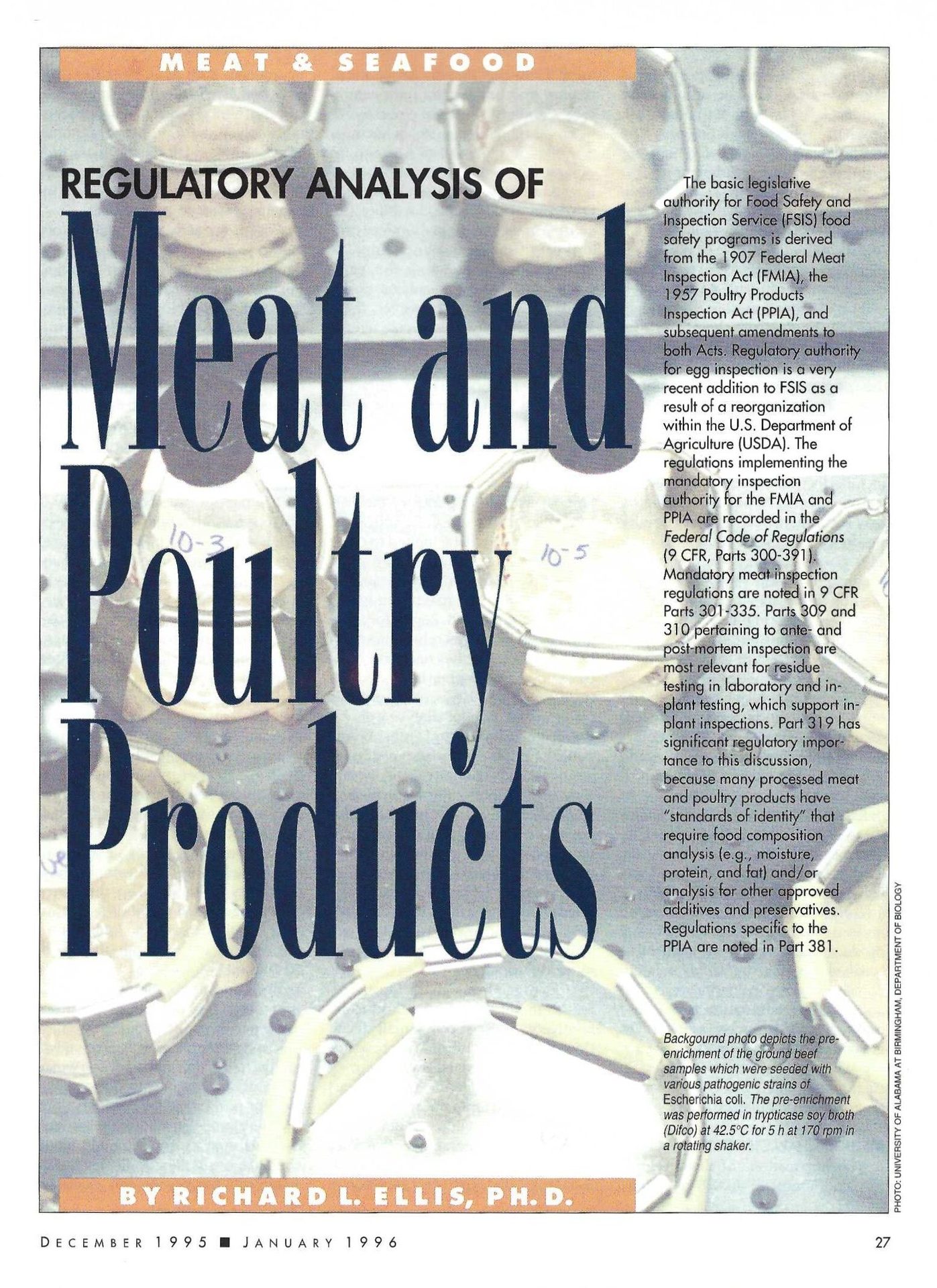
FIGURE 1. "Regulatory Analysis of Meat and Poultry Products" by Richard L. Ellis, Ph.D. from Food Testing & Analysis, December 1995/January 1996 (Credit: Food Safety Magazine)
“Another significant change under the Trump Administration was the April 2025 withdrawal of FSIS' proposed regulatory framework for Salmonella in raw poultry, a draft of which was published in August 2024 after years of careful consideration and engagement with scientific advisory committees and stakeholders.”


Regards,
Adrienne Blume, M.A.
Editorial Director

References
- Food Safety Matters Podcast. "Ep. 208. Reviewing 2025—A Year of Change for Food Safety Policy." Food Safety Magazine. December 23, 2025. https://www.food-safety.com/articles/10994-ep-208-reviewing-2025a-year-of-change-for-food-safety-policy.
- Henderson, B. "51 Cases of Infant Botulism Dating Back to 2023 Now Included in ByHeart Outbreak." Food Safety Magazine. December 10, 2025. https://www.food-safety.com/articles/10959-51-cases-of-infant-botulism-dating-back-to-2023-now-included-in-byheart-outbreak.
- Food Safety Matters Podcast. "Ep. 209. Helena Bottemiller Evich: The MAHA Effect on American Food Policy." Food Safety Magazine. January 13, 2026. https://www.food-safety.com/articles/11031-ep-209-helena-bottemiller-evich-the-maha-effect-on-american-food-policy.
- Henderson, B. and A. Blume. "A 2025 Timeline of U.S. Federal Food Safety Changes Under the Trump Admin." Food Safety Magazine. December 26, 2025. https://www.food-safety.com/articles/11004-a-2025-timeline-of-us-federal-food-safety-changes-under-the-trump-admin.
- Henderson, B. "Coalition Urges RFK Jr. to Fix Infant Formula Oversight Problems that Allowed Infant Botulism Outbreak." Food Safety Magazine. December 9, 2025. https://www.food-safety.com/articles/10946-coalition-urges-rfk-jr-to-fix-infant-formula-oversight-problems-that-allowed-infant-botulism-outbreak.
- Henderson, B. "Senator Demands Answers from ByHeart About Infant Formula Botulism Outbreak." Food Safety Magazine. December 23, 2025. https://www.food-safety.com/articles/11009-senator-demands-answers-from-byheart-about-infant-formula-botulism-outbreak.
- U.S. Food and Drug Administration (FDA). "HHS, FDA Announce Operation Stork Speed to Expand Options for Safe, Reliable, and Nutritious Infant Formula for American Families." March 18, 2025. https://www.fda.gov/news-events/press-announcements/hhs-fda-announce-operation-stork-speed-expand-options-safe-reliable-and-nutritious-infant-formula.
- FDA. "Closer to Zero: Reducing Childhood Exposure to Contaminants from Foods." Content current as of January 6, 2025. https://www.fda.gov/food/environmental-contaminants-food/closer-zero-reducing-childhood-exposure-contaminants-foods.
- Henderson, B. "FDA's Developing Rule to Tighten GRAS Oversight Moves to White House." Food Safety Magazine. December 2, 2025. https://www.food-safety.com/articles/10918-fdas-developing-rule-to-tighten-gras-oversight-moves-to-white-house.
- Abrams, S.A., J. Thomas Brenna, R. Clemens, et al. "FDA Expert Panel on Infant Formula 'Operation Stork Speed' June 2025: Part 2, Regulatory and Safety Considerations." Advances in Nutrition (January 12, 2026): 100584. https://advances.nutrition.org/article/S2161-8313(25)00222-4/fulltext.
- Food Safety Magazine Editorial Team. "Regan-Udall Report Supports FDA Infant Formula Safety Efforts." Food Safety Magazine. November 11, 2025. https://www.food-safety.com/articles/10866-regan-udall-report-supports-fda-infant-formula-safety-efforts.
- Reagan-Udall Foundation for the FDA. "Infant Formula Roundtable Series: Report on Cross-Sector Stakeholder Insights." October 2025. https://reaganudall.org/sites/default/files/2025-10/Infant_Formula_Roundtable_Series_Report.pdf.