SUPPLY CHAIN
By Jeremy Okwuosa, Expert Advisor, Active Food Safety LLC
Listen to Your Customers: How Complaint Intelligence Transforms Supplier Performance
Retailers and foodservice operators can protect major accounts by treating complaints not as normal operating conditions, but as intelligence

Image credit: 1shot Production/E+ via Getty Images
SCROLL DOWN
When I joined a food manufacturing and import organization supporting a complex, global supplier network, I inherited responsibility for customer complaint response, corrective action oversight, and supplier performance across multiple high-volume, commercial channels. The company worked with more than 20 co-manufacturing partners across multiple regions, supplying products into demanding retail and foodservice environments.
Early in my tenure, I conducted a comprehensive review of historical complaint data, shipment rejections, and supplier corrective and preventive action (CAPA) records. What emerged was not a collection of isolated incidents, but a clear pattern of recurring failures across several categories: sensory defects, packaging integrity issues, foreign material findings, labeling and code-date errors, and temperature-related shipment rejections.
These issues were not only frequent but also recurring, often tied to the same product categories and supplier sites. Supplier CAPA forms had been submitted. Investigations had been "closed." Documentation existed, but outcomes were not changing. The organization had extensive records of complaints and corrective actions, but documentation is not control, and compliance on paper is not capability in practice.
At the center of the problem was a fundamental operational gap: we lacked true visibility across the full supply chain, from production through transit, warehouse handling, and customer delivery. Release decisions depended heavily on point-in-time testing, with little understanding of execution conditions: staging time before freezing, processing bottlenecks, shipment exposure, or downstream handling upon arrival. In other words, we were measuring the product but not managing the process.
Recognizing that complaint reduction cannot be achieved through paperwork alone, I brought together my FSQA leadership team, which included senior managers responsible for supplier oversight, field execution, and corrective action verification. We implemented a structured supplier-development approach grounded in three principles:
- Focus on the vital few drivers
- Establish measurable supplier-owned execution plans
- Verify performance through real-world data, not remote closure.
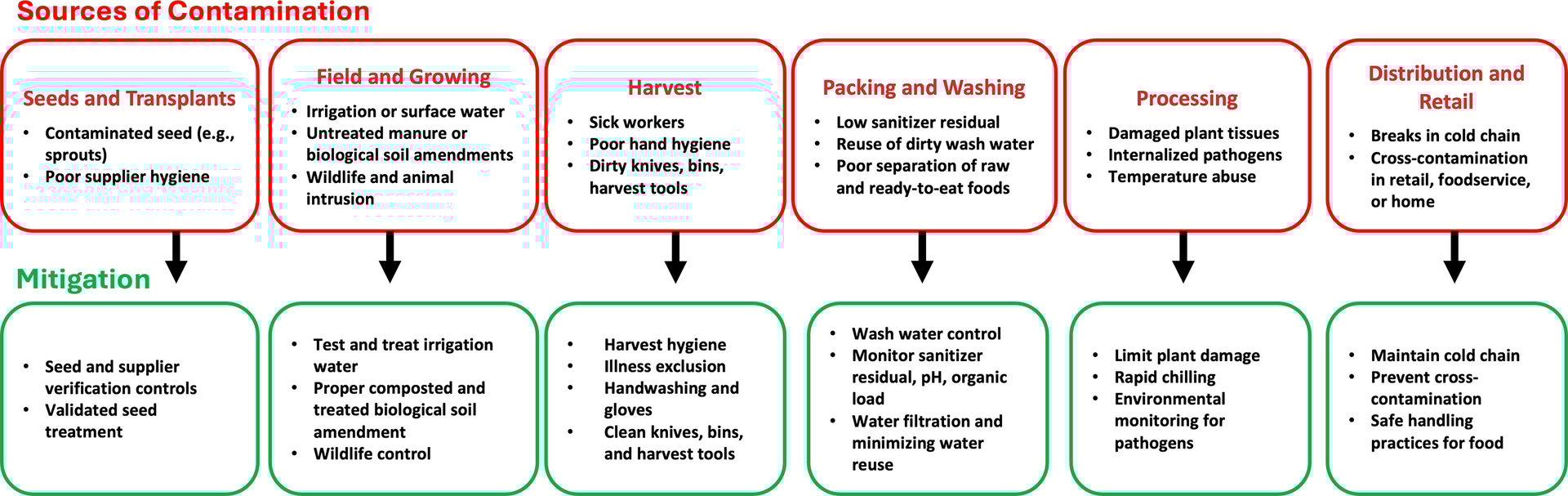
FIGURE 1. Sources of Pathogen Contamination and Methods of Mitigation (Credit: A. Abdelhamid)
Turning Complaints into Supplier Intelligence
The breakthrough came when we stopped treating complaints as isolated events and started treating them as intelligence. We organized all complaints into actionable categories and asked two questions:
- What are the top complaint drivers affecting customer confidence?
- Which supplier sites are most associated with repeat patterns?
This Pareto‑based structure—often called the 80/20 rule—created immediate clarity. In plain English, it means that roughly 80 percent of customer complaints typically come from about 20 percent of underlying causes or supplier sites. By identifying those "vital few," we stopped chasing dozens of minor issues and focused our technical firepower on the failure modes creating the greatest disruption.
For each priority category, I designed and deployed structured SMART (Specific, Measurable, Accountable, Realistic, and Time-based) corrective action plans and worked with my FSQA team to execute them with supplier partners through to verified closure. Importantly, these plans were elevated beyond the QA department. Supplier executive leadership was engaged directly, and accountability shifted to the business level. Each partner's CEO or COO was copied on expectations, asked to formally acknowledge ownership, and held accountable for execution.
Complaint reduction was no longer treated as a quality function. It became a business expectation.

“Some suppliers had placed TTR devices inside containers, but downstream teams often failed to retrieve them, did not understand their purpose, or did not report the data.”
Restoring Control over Shipment Integrity
One of the most disruptive complaint drivers involved temperature-related shipment rejections. Multiple imported frozen containers were being rejected upon receipt, with product destruction as the corrective action. Master cases showed signs of thawing and collapse. Visible ice buildup suggested humidity instability during transit. The impact was immediate: suppliers faced repeated losses, inventory risk increased, insurance claims escalated, and customer confidence was threatened.
I discovered that some suppliers had placed time-temperature-recording (TTR) devices inside containers, but downstream teams often failed to retrieve them, did not understand their purpose, or did not report the data. The devices existed, but the system did not.
Working directly with an engaged supplier partner, I architected a standardized monitoring protocol:
- Three temperature trackers per container (front, middle, and rear)
- Clear case identification for unloading crews
- Photo verification during loading
- Immediate reporting upon receipt
- Formal procedure sign-off by supplier leadership.
I trained my FSQA managers to interpret the data and embedded this into a supplier‑owned execution program, where TTR data was reviewed against each supplier's performance history to verify stability and prevent recurrence. The result was decisive: temperature-related container rejections were eliminated across the supplier network, data replaced assumptions, visibility replaced disputes, and control replaced frustration.
Supplier Development through Field Execution
Shipment integrity was only one part of the story. To address these concerns, we expanded our investigations upstream to supplier facilities, examining variations in raw material conditions, processing bottlenecks, and freezing performance. Recognizing that these failures were symptoms of a broader process breakdown, I pivoted our team from a remote-monitoring posture to a hands-on implementation strategy. I deployed my FSQA leadership team directly into supplier facilities to identify root causes and close operational gaps onsite.
Across multiple sites, we observed consistent breakdowns:
- Inconsistent raw material integrity and sorting discipline
- Processing bottlenecks without rapid chilling
- Inadequate environmental refrigeration or malfunctioning chillers
- Finished product staging times extended too long before frozen storage
- Weak recordkeeping and verification discipline.
My team and I worked alongside supplier operations to correct deficiencies, strengthen pre-operational sanitation execution, and reinforce process discipline until improvements were stable. This was supplier development through execution—not paperwork.
The Voice of the Consumer: Real-Time Intelligence
Beyond formal complaint channels, we began systematically monitoring online customer reviews. Consumer feedback appeared in real time, often weeks before official complaints reached our desk. Each week, the FSQA team reviewed online comments and shared insights with suppliers. Because reviews often lacked traceability codes, we distributed feedback across all suppliers in affected product categories.
Critically, we positioned this as awareness, not accusation: "This is what consumers are saying. Use this intelligence to strengthen your operations." This approach created early warning signals, fostered transparency across the supplier network, and demonstrated proactive commitment to the retailer. When issues began appearing online, we were already addressing them before they escalated into formal complaints.
“Complaint reduction is not a CAPA function. It is a leadership function.”
Retailer Recognition and Sustained Improvement
As our internal systems took hold, the true test of the framework arrived. Approximately two weeks after I had identified the top complaint drivers and secured executive commitment from our suppliers, I received formal notice from a major national retail partner. Their FSQA leadership was clear: our complaint volume was excessive, ranking us among the most challenged in their supplier network.
Because we had already transitioned from reactive tracking to complaint intelligence, I was able to respond not with defensive posturing, but with a roadmap. I acknowledged the data and demonstrated that we were already mid-execution:
- We had already identified the top ten failure modes across the network
- We had isolated the specific supplier sites responsible for the volume
- We had already deployed SMART action plans with executive-level sign-off.
The retailer's posture shifted immediately from punitive to collaborative. After reviewing the rigor of our SMART plans, they moved us into a structured monthly progress review cycle rather than escalating to a "stop-buy" or delisting.
It is also important to recognize a reality often missed in supply chain analytics: the "tail" of legacy inventory. In categories with a 24-month shelf life, complaint trends do not shift overnight. Many complaints received during that first year were tied to products manufactured and packed long before our new controls were in place.
By distinguishing between legacy inventory and current production, we showed the retailer that execution was stable and that, as older product was flushed out, confidence returned—eventually leading the retailer to reduce their oversight intensity.
The Broader Lesson: Complaint Reduction is Culture
The most important takeaway is simple: complaint reduction is not a CAPA function. It is a leadership function. Sustained improvement requires:
- Senior management commitment
- Supplier accountability at the executive level
- Cross-functional alignment between procurement and compliance
- Field verification, not remote paperwork closure
- A culture that treats complaints as signals, not interruptions.
When organizations listen to customers with discipline, act with urgency, and develop suppliers through execution, complaint reduction becomes more than a quality metric; it becomes a competitive advantage.
Education Opportunities
As supply chains become more digital and automated, many food fraud programs reflect older operating models. While most food safety professionals are well trained in hazard analysis and preventive controls, fewer have received formal training in food fraud vulnerability, food document fraud risk, or integration with enterprise risk management systems.
To help address the industry-wide capability gap, the Food Fraud Prevention Think Tank offers free, on-demand training through comprehensive MOOCs (Massive Open Online Courses) that cover vulnerability assessments, supply chain mapping, prevention strategies, and integration with enterprise risk management. These courses provide the foundational knowledge and practical tools needed to build or update a food fraud prevention program. Visit the Food Fraud Prevention Think Tank to access these resources and start building a prevention strategy today.
Closing Thought
Customer complaints should never be accepted as normal operating conditions. The goal is not to manage them—it is to eliminate their root causes and drive complaint volume as close to zero as possible. The real question is whether organizations treat complaints as background noise, or as the clearest voice in the supply chain telling them exactly where capability must be built next.
Acknowledgment
Claude AI assisted with content synthesis and drafting under expert direction, with all conceptual frameworks, technical content, and editorial decisions determined by the authors.
References
- International Organization for Standardization (ISO). "ISO 22380:2018: Security and resilience—Authenticity, integrity and trust for products and documents—General principles for product fraud risk and countermeasures." Edition 1, 2018. https://www.iso.org/standard/73857.html.
- The 107th Congress. "H.R.3763—Sarbanes-Oxley Act of 2002." July 30, 2002. https://www.congress.gov/bill/107th-congress/house-bill/3763.
Jeremy Okwuosa is the Founder and Principal Consultant of Public Food Safety Solutions LLC and a senior FSQA implementation specialist with over 25 years of experience in transforming complex, high-risk food manufacturing operations across facilities regulated by USDA-FSIS, FDA, and USDC. His career includes progressive FSQA leadership roles with Johnsonville Foods, Genoa Sausage, Kayem Foods, Cozy Harbor Seafood, and Chabaso Bakery.
Most recently, he served as Vice President of FSQA at The Fishin' Company, supporting retail, foodservice, and club markets. His experience spans seafood, meat and poultry, bakery, RTE, and startup operations, with deep expertise in pathogen control, GFSI certification (BRCGS, SQF), and food safety culture transformation. He has led successful facility recoveries following FDA enforcement actions, guided organizations through consent-decree compliance, and supported multi-pathogen risk reduction efforts while preserving workforce stability.
He holds HACCP (USDA, FDA, Seafood), BRCGS Practitioner, FSMA PCQI, SQF Practitioner, Food Defense, and ServSafe Manager certifications, and earned a B.S. degree in Animal Science from Southern University A&M College. As an Active Food Safety LLC advisor, Jeremy supports clients in operationalizing food safety systems that endure long after the engagement concludes.