30th Anniversary Retrospective

A Look at Regulatory Approaches to Pesticide Residues in Foods—Then vs. Now
SCROLL
DOWN
Welcome to this issue's Anniversary Retrospective, where I examine trends in food safety science and regulation from the present day vs. the mid-1990s, when Food Safety Magazine debuted as Food Testing & Analysis.1,2,3,4
Last month, we looked back at nutrition labeling in 1995, the year after the Nutrition Facts label was established per the Nutrition Labeling and Education Act of 1990, vs. the Food and Drug Administration's (FDA's) currently proposed "Front-of-Package" (FOP) nutrition label.4 The FOP label is currently undergoing comment review and is being heavily promoted by the Trump administration's "Make America Healthy Again" (MAHA) agenda.
In this month's Retrospective, we'll take a look at another issue that was on regulators' and consumers' minds in the mid-90s and is still of intense interest today—pesticide residues in foods.
Federal Pesticide Residues Monitoring: Then and Now
In the "Ask the Regulators" column from the June/July 1996 issue of Food Testing & Analysis (Figure 1), former FDA official Dr. James T. Tanner invites three colleagues to answer questions on the topic of pesticide residues.5 The first question concerns the need to wash fresh produce to eliminate residues. The stated advice of rinsing with water (no soap) and throwing away the outer leaves of leafy vegetables still holds true today. Although the guidance notes that it may not be possible to completely eliminate pesticide residues from fresh produce, washing helps. For an added layer of protection, three federal agencies are charged with monitoring pesticide residues in domestic and imported foods—the subject of the next two questions.
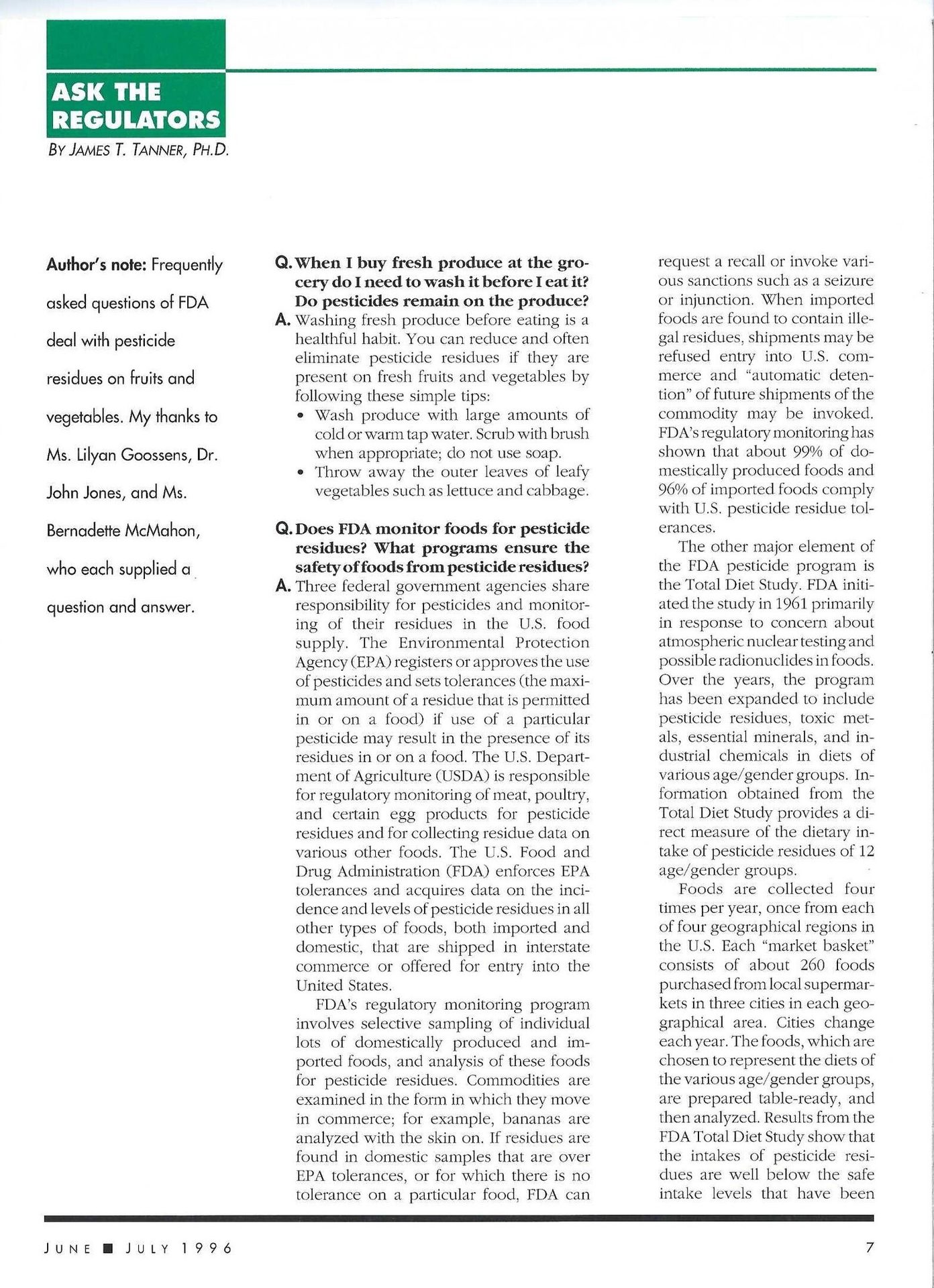
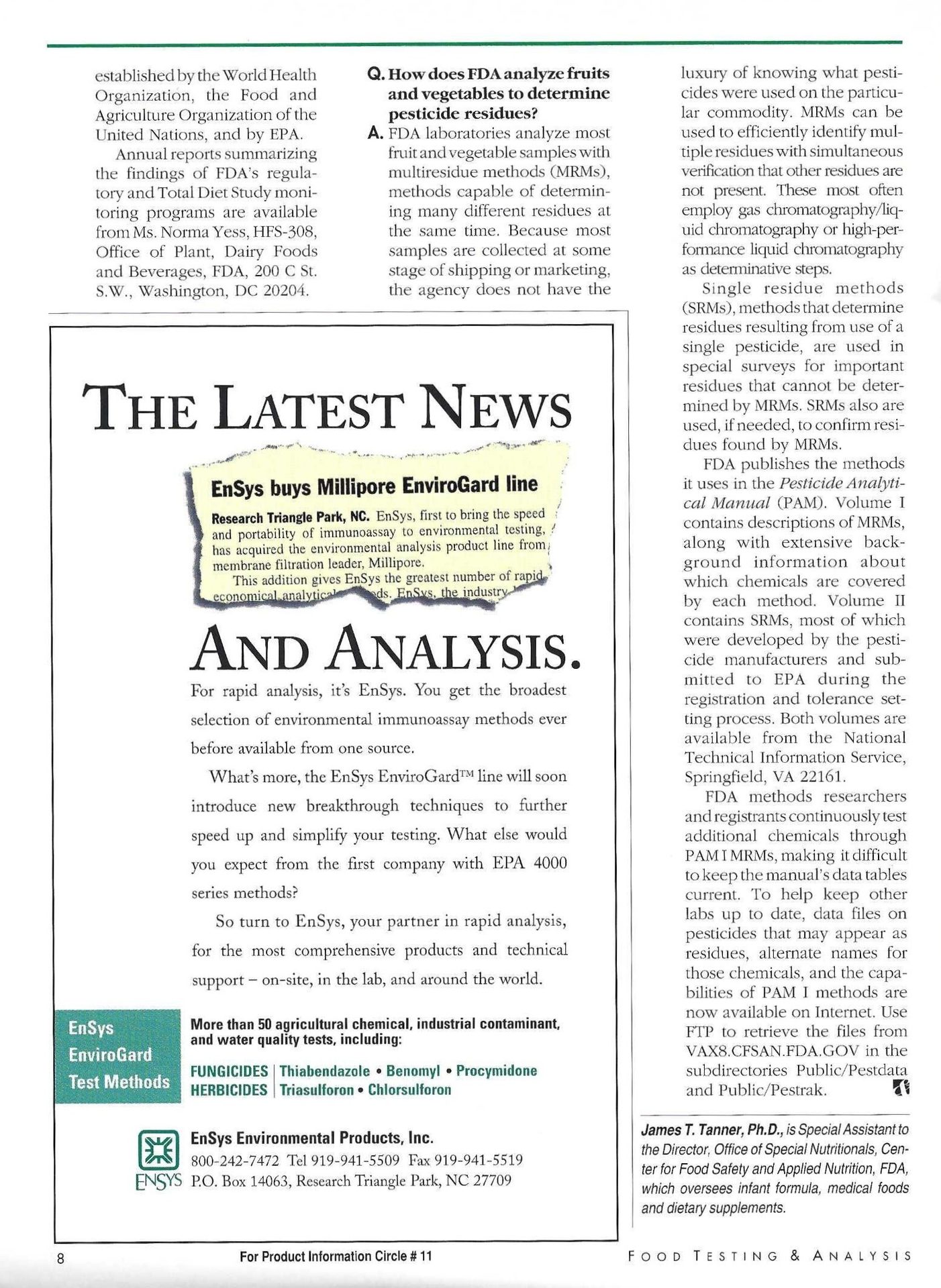
FIGURE 1. "Ask the Regulators" Column from Food Testing & Analysis, June/July 1996 (Credit: Food Safety Magazine)
As Dr. Tanner's colleagues explain, the Environmental Protection Agency (EPA) has responsibility for registering and approving the use of pesticides, as well as setting tolerances for pesticide residues in or on foods; FDA monitors residues through its Pesticide Residue Monitoring Program and Total Diet Study, and the U.S. Department of Agriculture (USDA) tracks pesticide residues in meat, poultry, and egg products, as well as other foods, through its Pesticide Data Program.
The 1996 column stated, "FDA's regulatory monitoring has shown that about 99% of domestically produced foods and 96% of imported foods comply with U.S. pesticide residue tolerances."5 More recently, FDA's latest Pesticide Residue Monitoring Program report, released in September 2024, showed that only 96.2 percent of domestic samples and 89.5 percent of imported samples collected from 2021–2022 were compliant with pesticide residue tolerances set by EPA.6 Meanwhile, USDA testing for 2023 showed that more than 99 percent of domestic and imported foods did not exceed pesticide residue tolerances.7 USDA's testing for 2023 encompassed more human food samples—9,832, vs. FDA's 2,800 samples for the previous year—but the discrepancy in findings for overall pesticide residues between FDA and USDA, just a year apart, is interesting to note.
“EPA is charged with ensuring that all pesticides used on foods consumed in the U.S. meet the stringent safety standards set by the Food Quality Protection Act. EPA must also reevaluate the safety data of all pesticides every 15 years.”


Regulatory and Consumer Concern Over Pesticide Residues
Coincidentally, the Food Quality Protection Act (FQPA)—which fundamentally changed EPA's regulation of pesticides—was signed into law by President Clinton on August 3, 1996, just two months after Dr. Tanner's column was published in Food Testing & Analysis. The FQPA amended the Federal Insecticide, Fungicide, and Rodenticide Act (FIRFA) and the Federal Food, Drug, and Cosmetic Act (FD&C Act), and directed EPA to reassess pesticide residues on food, with emphasis on the unique vulnerability of children.8 The ensuing, ten-year reassessment of 9,721 pesticides led to the revocation or modification of nearly 4,000 residue tolerances.
According to EPA, "The FQPA requires an explicit determination that a pesticide's use on food is safe for children and includes an additional safety factor, tenfold unless data show a different factor to be protective, to account for uncertainty in data relative to children."9 Today, EPA is charged with ensuring that all pesticides used on foods consumed in the U.S. meet the stringent safety standards set by the FQPA. EPA must also reevaluate the safety data of all pesticides every 15 years.
Despite federal protections, growing worries over the potential, cumulative health effects of pesticide residues are reflected in consumer sentiment. In a recent survey conducted by the International Food Information Council (IFIC), 46 percent of American adults surveyed expressed concern about pesticide residues in foods.10 These concerns are echoed by advocates of President Trump and Secretary Kennedy's MAHA movement—particularly parents concerned about the potential contamination of their children's food.
MAHA's Devolving Stance on Pesticides in Foods
Department of Health and Human Services (HHS) Secretary Kennedy has promised to address a number of food contamination concerns on the MAHA agenda—including synthetic food colorants and other additives, as well as pesticide residues, bacterial contamination, and heavy metals. However, recent moves by the Department of Health and Human Services appear to run counter to these promises.
For example, CDC's Foodborne Diseases Active Surveillance Network (FoodNet) program recently reduced surveillance from eight important foodborne pathogens to just two (Salmonella and Shiga-toxin-producing Escherichia coli), citing insufficient funding.11 Furthermore, the much-anticipated release of the MAHA Strategy on September 9 drew harsh criticism for its friendliness to the agricultural chemicals industry and its failure to endorse increased regulation for toxic pesticides. Some, like glyphosate, have been found to cause cancer in agricultural workers;12 however, EPA has determined that "there are no risks of concern to human health when glyphosate is used in accordance with its current label."13
For all its stated concerns about "making America's children healthy again" and "healthy foods and healthy families," the MAHA movement under Secretary Kennedy seems to be turning a blind eye to pesticide residues. Pesticides are mentioned exactly six times in the September MAHA Strategy, and the only mention of pesticides in relation to food reads as follows: "EPA, partnering with food and agricultural stakeholders, will work to ensure that the public has awareness and confidence in EPA's pesticide robust review procedures and how that relates to the limiting of risk for users and the general public and informs continual improvement."14
“According to critics, the September MAHA Strategy report has pivoted from the May MAHA Report's concerns over pesticide residues and bowed to agricultural and chemical industry demands.”
This apparent nonchalance over pesticide residues is a stark contrast to the MAHA Report released in May 2025, which mentions pesticide issues many more times, and with much greater specificity. The May report states, "Pesticides, microplastics, and dioxins are commonly found in the blood and urine of American children and pregnant women—some at alarming levels" and "Virtually every breastmilk sample… tested in America contains some level of persistent organic pollutants (POPs), including pesticides, microplastics, and dioxins." Furthermore, the May report acknowledges that "More than eight billion pounds of pesticides are used each year in food systems around the world, with the U.S accounting for roughly 11%, or more than one billion pounds."15
The real kicker from the May 2025 MAHA Report regarding pesticides reads as follows: "Children are particularly vulnerable to chemicals [including pesticides] during critical stages of development—in utero, infancy, early childhood, and puberty. Research suggests that for some chemicals, this cumulative load of exposures may be driving higher rates of chronic childhood diseases"15 (emphasis added).
During Kennedy's previous work as an environmental lawyer, he spoke out against the dangers of agricultural pesticides and herbicides use. He also made promises during the 2024 presidential campaign to ban some agricultural chemicals that are restricted in other countries, garnering support from the MAHA movement. However, after the MAHA Report was released in May 2025, agricultural groups weren't shy about expressing their displeasure. The Farm Bureau Federation and pesticides lobby group CropLife America released statements calling the MAHA Report "deeply troubling" and "misleading and unfounded" on the topics of pesticides and agriculture.16,17 Additionally, CropLife America publicized 17 recommendations it wanted to see in the final MAHA Strategy.18
According to critics, the September MAHA Strategy report has pivoted from the May MAHA Report's concerns over pesticide residues and bowed to agricultural and chemical industry demands. "It looks like pesticide industry lobbyists steamrolled the MAHA Commission's agenda," noted Environmental Working Group President Ken Cook.19 Furthermore, pediatrician and Boston College professor Dr. Philip Landrigan observed in an NPR commentary, "This report says almost nothing about toxic chemicals and their effects on human health. It seems like a complete break from what Secretary Kennedy talked about."20
The Trump Administration's recent MAHA Strategy doesn't appear to match its earlier rhetoric on pesticide residues and food safety—which has come as a surprise to some (think MAHA parents who want to know their children's food isn't tainted with unsafe chemicals) and not so much of a surprise to others (including public health professionals, scientists, and doctors who are growing increasingly concerned about Secretary Kennedy's leadership of HHS21). However, it is hoped that the three federal agencies responsible for tracking pesticides in foods—EPA, FDA, and USDA—will remain enabled and empowered to monitor and mitigate the potential health harms from pesticide residues in the U.S. food supply.
We can expect another round of pesticide residue reports from FDA and USDA this year, detailing findings for 2023 and 2024—as always, we'll continue to keep you updated. Also, make sure to watch this space for one last Anniversary Retrospective in the December/January issue!
Regards,
Adrienne Blume, M.A.
Editorial Director

References
- Blume, A. "Celebrating 30 Years of Food Safety Magazine—and a Look Back at Food Safety Then vs. Now." Food Safety Magazine February/March 2025. https://digitaledition.food-safety.com/february-march-2025/department-editors-letter/.
- Blume, A. "A Look Ahead at the 2025 Food Safety Summit—And Another Look Back From FSM." Food Safety Magazine April/May 2025. https://digitaledition.food-safety.com/april-may-2025/department-editors-letter/.
- Blume, A. "A Look at Poultry Safety and Salmonella Testing—Then vs. Now." Food Safety Magazine June/July 2025. https://digitaledition.food-safety.com/june-july-2025/department-editors-letter/.
- Blume, A. "Celebrating 30 Years of Food Safety Solutions with FSM—And a Look Back at Nutrition Labeling." Food Safety Magazine August/September 2025. https://digitaledition.food-safety.com/august-september-2025/department-editors-letter/.
- Tanner, J.T. "Ask the Regulators." Food Testing & Analysis June/July 1996: 7,8.
- Henderson, B. "Summary of Pesticides Found in U.S. Food Supply Based on FDA Monitoring in FY 2022." Food Safety Magazine. September 4, 2024. https://www.food-safety.com/articles/9716-summary-of-pesticides-found-in-us-food-supply-based-on-fda-monitoring-in-fy-2022.
- Henderson, B. "USDA Testing for 2023 Shows 99 Percent of Foods Do Not Exceed Pesticide Residue Tolerances." Food Safety Magazine. November 11, 2024. https://www.food-safety.com/articles/9895-usda-testing-for-2023-shows-99-percent-of-foods-do-not-exceed-pesticide-residue-tolerances.
- U.S. Environmental Protection Agency (EPA). "Summary of the Food Quality Protection Act." Last updated July 25, 2025. https://www.epa.gov/laws-regulations/summary-food-quality-protection-act.
- EPA. "Food and Pesticides." Last updated February 13, 2025. https://www.epa.gov/safepestcontrol/food-and-pesticides.
- Henderson, B. "Survey: Confidence in U.S. Food Safety Hits Record Low, Foodborne Pathogens Are Top Concern." Food Safety Magazine. July 31, 2025. https://www.food-safety.com/articles/10574-survey-confidence-in-us-food-safety-hits-record-low-foodborne-pathogens-are-top-concern.
- Henderson, B. "CDC Slashes FoodNet Surveillance From Eight Foodborne Pathogens to Two." Food Safety Magazine. August 26, 2025. https://www.food-safety.com/articles/10646-cdc-slashes-foodnet-surveillance-from-eight-foodborne-pathogens-to-two.
- National Institutes of Health. National Library of Medicine. "Common weed killer glyphosate increases cancer risk by 41%, study says." From CNN News. February 14, 2019. https://www.ncbi.nlm.nih.gov/search/research-news/3492/.
- EPA. "Glyphosate." Last updated May 9, 2025. https://www.epa.gov/ingredients-used-pesticide-products/glyphosate.
- The White House. "Strategy Report: Make Our Children Healthy Again." September 9, 2025. https://www.whitehouse.gov/wp-content/uploads/2025/09/The-MAHA-Strategy-WH.pdf.
- The White House. "The MAHA Report." May 2025. https://www.whitehouse.gov/wp-content/uploads/2025/05/MAHA-Report-The-White-House.pdf.
- Farm Bureau. "Farm Bureau Statement on MAHA Report." May 22, 2025. https://www.fb.org/news-release/farm-bureau-statement-on-maha-report.
- CropLife America. Letter to Secretary Robert F. Kennedy Jr. June 27, 2025. https://static1.squarespace.com/static/5faeee45a363746603d1c6e1/t/68629bc0d3bf8d17d084a557/1751292864792/Final+CLA+Policy+Recommendations+ltr+MAHA+Commission.pdf.
- CropLife America. "CropLife America Responds to MAHA Commission, Offers 17 Policy Recommendations for August Policy Report." June 27, 2025. https://www.croplifeamerica.org/news-releases/cla-maha-commission-letter.
- Henderson, B. "What the Final MAHA Report Could Mean for Food Safety." Food Safety Magazine. September 9, 2025. https://www.food-safety.com/articles/10681-what-the-final-maha-report-could-mean-for-food-safety.
- Aubrey, A. "MAHA strategy flip flops on pesticides." September 10, 2025. NPR News. https://www.npr.org/2025/09/10/nx-s1-5535848/maha-strategy-flip-flops-on-pesticides.
- Henderson, B. "Public Health Professionals, Groups Demand Resignation of HHS Secretary RFK Jr." Food Safety Magazine. September 4, 2025. https://www.food-safety.com/articles/10669-public-health-professionals-groups-demand-resignation-of-hhs-secretary-rfk-jr.