CYBERSECURITY AND FOOD DEFENSE
By Robert A. Norton, Ph.D., Professor of Veterinary Infectious Diseases and Coordinator, National Security and Defense Projects, Office of the Senior Vice President of Research and Economic Development, Auburn University; Cristopher A. Young, COL, USA (Ret.), D.V.M., M.P.H., Diplomate A.C.V.P.M., Professor of Practice, College of Agriculture, Auburn University and Adjunct Professor, College of Veterinary Medicine, Department of Pathology, University of Georgia; and Soren Rodning, M.S., D.V.M., D.ACT., Professor and Extension Specialist, Auburn University and Coordinator for Alabama Beef Quality Assurance and Pork Quality Assurance programs
From Farm to Threat: Integrating Biosurveillance, Biointelligence, and Biosecurity (B3) into the Food Safety Enterprise—Part 1
The AU-BISR system connects the farm, the lab, and the decision-maker with actionable, early-warning intelligence for biological threats
Image credit: Elena Perova/iStock/Getty Images Plus via Getty Images
SCROLL DOWN
Food safety professionals understand risk. They are trained in Hazard Analysis and Critical Control Points (HACCP), allergen control, environmental monitoring, traceability, and regulatory response. They know how to investigate Listeria monocytogenes in a drain line, interpret warning signs in a processing environment, and respond when regulators identify deficiencies. But times are changing, and biological threats are evolving. Increasingly, the more important question is whether the biosurveillance architecture surrounding the food system is capable of detecting biological threats early enough to matter—meaning before contamination reaches the production floor, moves through the supply chain, or results in illness, recall, or business disruption. The answer, at present, is no.
This article introduces food safety professionals and food businesses to a transformative framework developed at Auburn University, the "Agricultural and Urban Intelligence, Surveillance, and Reconnaissance" (AU-BISR) System, which is governed by a unifying Biosurveillance, Biointelligence, and Biosecurity (B3) operational architecture. AU-BISR is not a public health curiosity or a defense sector abstraction. It is a directly applicable early-warning architecture for the food system, one that reconceptualizes farms, processing facilities, and urban food environments as persistent biological sensor platforms capable of detecting threats weeks before a single clinical case is confirmed or a single recall notice is issued.
Why Legacy Systems Cannot Fully Protect the Food Supply
The current national biosurveillance apparatus is built around institutional boundaries that are fundamentally incompatible with the emerging speed of modern biological threats. The U.S. Centers for Disease Control and Prevention's (CDC's) Foodborne Diseases Active Surveillance Network (FoodNet), long considered the gold standard of foodborne illness tracking, was scaled back in mid-2025 to monitor only two pathogens instead of eight. That decision alarmed food safety experts who regard FoodNet as the only active federal multi-pathogen monitoring system in the country. The U.S. Food and Drug Administration's (FDA's) Office of Coordinated Outbreak Response, Evaluation, and Emergency Preparedness (CORE+EP) and CDC's PulseNet laboratory network continue to function, but both are inherently reactive. They confirm outbreaks that have already occurred, trace pathogens already present in the food supply, and generate alerts often after consumers have already been harmed.
This architecture reflects its historical design. Public health agencies own surveillance data. The intelligence community owns analytical products. Operational agencies own response authority. Each of those boundaries represents a break in the information chain. Each break allows a biological event to advance while human and institutional systems work to catch up.
The Highly Pathogenic Avian Influenza (HPAI) H5N1 crisis that has devastated the U.S. poultry industry since 2022 is the most visible demonstration of that failure. Despite a U.S. Department of Agriculture (USDA) investment exceeding $1 billion in HPAI response (including expanded Wildlife Biosecurity Assessments and the deployment of 20 epidemiologists for facility-level audits), the fundamental architecture remains reactive. USDA's Animal and Plant Health Inspection Service (APHIS) confirms pathogen presence after entry into the food system, and the food system absorbs the economic shock. In cases of HPAI, taxpayer indemnity payments to poultry producers continue to disincentivize the biosecurity upgrades that could meaningfully reduce HPAI prevalence over time. As a result, consumers pay the price at the egg and dairy case.
The question is not whether the food industry needs better biosurveillance—it certainly does. The questions that need rapid answers are:
- What is the best design for a genuinely integrated, prospective architecture?
- Is the food safety community prepared to build it?
“The result is a system that is never merely watching a biological event unfold, but rather continuously analyzing, predicting, and acting against it in parallel.”


Introducing the B3 Framework
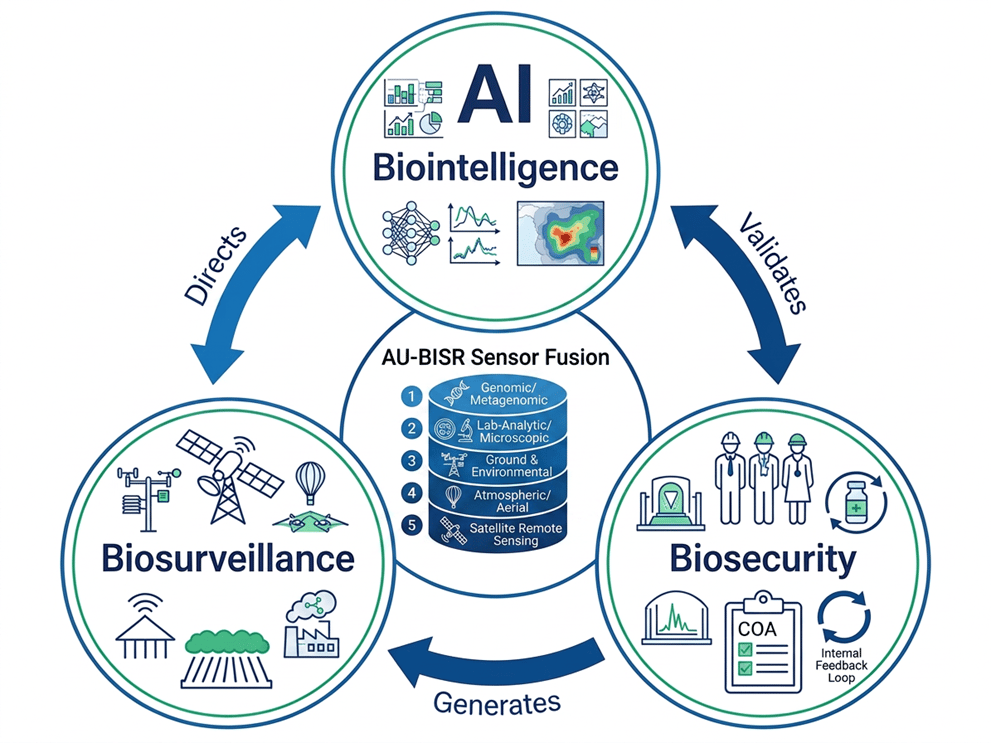
The B3 framework, developed by Norton, Sachs, Young, and Bragg at Auburn University, reconceptualizes three historically siloed domains not as a sequential pipeline (i.e., collect data, analyze and interpret it, then respond), but instead as a continuously fused, mutually generative analytical triad:
- Biosurveillance: Biosurveillance is actively directed by biointelligence products that re-task collection assets in real time.
- Biointelligence: Biointelligence is continuously validated by biosecurity outcomes that feed intervention effects back into the analytical pipeline.
- Biosecurity: Biosecurity course-of-action (COA) execution generates new environmental and chemical signature data that re-enters the biosurveillance collection cycle as raw input.
Each domain simultaneously feeds, informs, and sharpens the other two. The result is a system that is never merely watching a biological event unfold, but rather continuously analyzing, predicting, and acting against it in parallel (Figure 1).
FIGURE 1. The B3 triad showing how AU-BISR connects the farm, the lab, and the decision-maker. Unlike legacy surveillance systems that collect data, then analyze it, then seek authorization to respond, the B3 framework fuses biosurveillance, biointelligence, and biosecurity into a single, continuously executing loop. For food safety professionals, this means actionable, early-warning intelligence rather than post-outbreak notifications. (Credit: R. Norton, generated via Claude 4.6)
For food safety professionals, this reframing carries direct operational consequences. Under the B3 architecture, a poultry processing complex is not simply a HACCP-controlled facility subject to routine USDA inspection. It is a persistent collection platform that continuously detects chemical, thermal, acoustic, and biological signatures. When those signatures are properly instrumented and analytically integrated, they can detect pathogens of interest, novel zoonotic pathogens, or deliberate biological tampering up to hours, days, or perhaps weeks before any clinical symptom appears or any laboratory confirmation is issued.
The AU-BISR Five-Layer Sensor Architecture
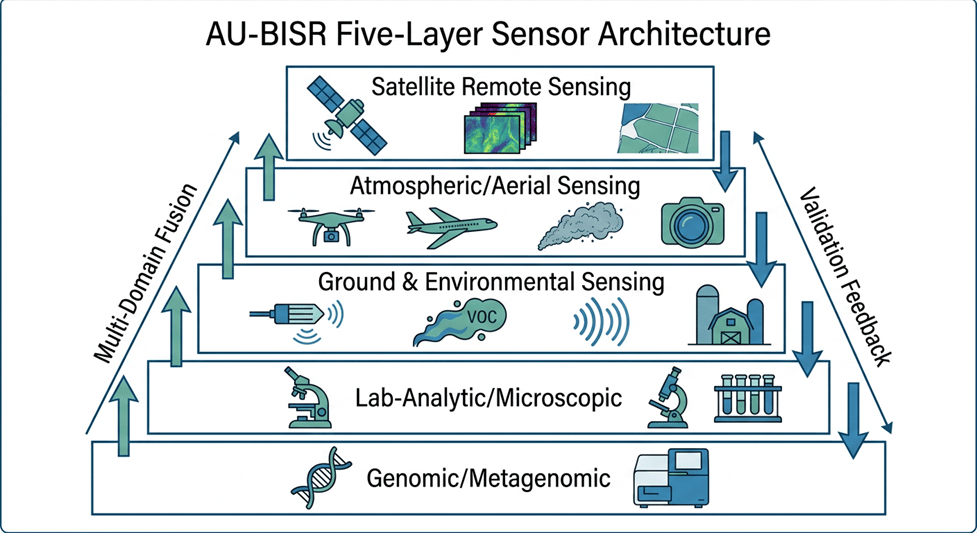
AU-BISR operationalizes the B3 framework through a stacked, five-layer sensor architecture, thereby becoming the physical backbone of next-generation food system biosurveillance:
- Layer 1—Genomic/Metagenomic: Nucleic acid sequencing and microbial community profiling provide the molecular foundation for pathogen identification. This serves as the evidentiary anchor for all higher-layer detections.
- Layer 2—Lab-Analytic/Microscopic: Laboratory diagnostic instrumentation, combined with Layer 1, generates an algorithmically derived biological fingerprint meeting clinical and legal standards for validated pathogen identification.
- Layer 3—Ground and Environmental Sensing: In-situ measurements of chemical, thermal, acoustic, and ecological signatures are taken at the facility and landscape level, including volatile organic compound (VOC) profiling of animal housing, soil and water sensors, and acoustic pattern-of-life monitoring. This is the primary foodborne pathogen and pre-clinical detection tier for food system applications.
- Layer 4—Atmospheric/Aerial Sensing: Drones, balloons, and fixed-wing platforms are used for airborne aerosol sampling, plume characterization, and thermal mapping across production corridors, extending biosurveillance beyond the facility perimeter.
- Layer 5—Satellite Remote Sensing: Wide-area hyperspectral, multispectral, and electro-optical collection provide state- and region-wide coverage, enabling detection of animal distress, vegetation stress, water body anomalies, and facility-level activity patterns across entire agricultural production regions.
It is important to note that Layers 3–5 are Measurement and Signature Intelligence (MASINT) collection tiers. They detect the invisible physical fingerprints of biological events, chemical plumes, thermal anomalies, acoustic deviations, and spectral changes long before any pathogen can be cultured in a laboratory or any animal presents clinically. A single VOC sensor array at a poultry house exhaust port, calibrated to the facility's seasonal baseline, can detect, for example, HPAI-associated volatilome shifts hours or days before mortality begins. A satellite pass over a migratory flyway corridor can also flag environmental stress patterns consistent with waterfowl congregation weeks before wild bird sampling confirms viral circulation. These are not theoretical capabilities; they are deployable, commercially available sensing modalities that AU-BISR integrates into a unified analytical framework (Figure 2).
FIGURE 2. Where your facility fits: the AU-BISR sensor stack from the poultry house to the satellite pass. The AU-BISR architecture begins where food safety professionals already operate—at the facility level. Ground sensors (Layer 3) detect VOC deviations, acoustic anomalies, and thermal pattern-of-life shifts days before clinical signs emerge. Aerial platforms (Layer 4) extend coverage across production corridors. Satellites (Layer 5) provide regional hyperspectral monitoring across entire flyway and supply chain geographies. Layers 1 and 2 anchor every detection to a clinically validated, legally defensible biological fingerprint. (Credit: R. Norton, generated via Claude 4.6)
The Products of Logic (PoL) Framework: From Raw Data to Actionable Decision
Raw sensor data has no value to a food safety manager unless it can be transformed into an actionable intelligence (i.e., validated insight) product. The AU-BISR Products of Logic (PoL) framework provides this transformation pipeline across five levels (Table 1).
TABLE 1. AU-BISR Products of Logic Framework (Credit: R. Norton et al.)
Understanding Risk Masks
A risk mask is a geospatial analytical product generated at Products of Logic Level 1 (PoL 1) within the AU-BISR system. It is a georeferenced grid layer, typically a raster image (i.e., digital image of pixels) overlaid on a map in which each cell is classified or color-coded to indicate the probability or intensity of biological risk at that location, based on single-sensor data processed by AI algorithms. In plain terms, a risk mask answers the question: "Where on the map are conditions favorable for a biological threat to emerge?"
Risk masks are produced by applying sensor-specific algorithms to raw PoL 0 collection data from AU-BISR's sensor layers:
- Spectral mask (Layer 5 satellite hyperspectral data): Marks geographic cells where wetlands, irrigated cropping areas, and dense poultry facilities converge near food processing or population centers, flagging locations where conditions favor the presence of potential zoonotic spillover (e.g., concentrated waterfowl experiencing high mortality) or foodborne pathogen persistence (e.g., livestock near leafy vegetable fields).
- Chemical mask (Layer 3 VOC sensors): Highlights animal production facilities with exhaust VOC profiles that have drifted statistically from their established seasonal baseline, possibly indicating potential early-stage pathogen activity before any clinical sign appears.
- Thermal mask (Layer 3–4 infrared sensors): Flags facilities with anomalous heat signatures in animals (elevated body temperature), indicating unusual metabolic activity consistent with infection.
For the food safety enterprise, PoL 4 decision products are the operational deliverable. They translate complex, multi-sensor fusion outputs into prioritized, actionable recommendations, (e.g., immediately target this poultry complex for enhanced serologic sampling; pre-position diagnostics along this transport corridor before the next flock movement; tighten biosecurity protocols at this processing facility in advance of the seasonal migratory flyway activation, etc.).
The PoL framework uses advanced but interpretable AI tools including Bayesian Evidence Fusion at PoL 2, Gradient Boosted Decision Trees with SHapley Additive exPlanations (SHAP) explainability and Long Short-Term Memory (LSTM) neural networks at PoL 3, and rule-based expert systems at PoL 4, while preserving a complete, auditable evidence chain from raw sensor collection to final decision product. This PoL traceability architecture ensures that a COA recommending, for example, flock depopulation or facility shutdown can withstand administrative proceedings and regulatory scrutiny.
“This is the fundamental operational value of B3 for the food system: the detection-to-decision timeline is not merely compressed, it is fundamentally restructured.”
What B3 Means for Food Businesses: An HPAI Pre-Clinical Scenario
Consider a realistic scenario: The time is late autumn. HPAI H5N1 is active in migratory waterfowl transiting the Central Flyway. A major egg layer operation sits adjacent to a wetland complex regularly used by migratory ducks, many of which are dying.
Under the current system, the operator conducts scheduled biosecurity audits, maintains surveillance under USDA APHIS guidance, and waits. When the virus eventually enters the flock, mortality begins within 24–48 hours of clinical onset (1–3 days after clinical signs). APHIS is notified. Depopulation begins. Economic loss is measured in millions; supply chain disruption in weeks; egg price impact in months.
Under AU-BISR B3, the scenario unfolds differently:
- Weeks before spillover: Layer 5 satellite hyperspectral collection flags an elevated Normalized Difference Water Index (NDWI) anomaly at the adjacent wetland, consistent with increased waterfowl congregation. A PoL 1 spectral mask flags the facility corridor as elevated risk.
- Days before clinical onset: Layer 3 GC-MS VOC sensors at the poultry house exhaust detect a 2.3-sigma deviation from the facility's seasonal volatilome baseline, meaning consistent with early respiratory pathology. Acoustic sensors simultaneously detect reduced or altered vocalization (e.g., raspy breathing, rales) during morning feeding periods. A PoL 2 multi-sensor fusion product correlates these signatures with the upstream wetland anomaly and an anomalous nocturnal thermal profile in the barn.
- Before a single bird dies: A PoL 3 Cluster Escalation Score reaches the high-alert threshold. A PoL 4 COA is generated: targeted serologic survey at this facility within 12 hours, biosecurity tightening at adjacent complexes, and pre-positioning of diagnostics and response teams along the transport corridor.
The operator receives an actionable recommendation, rather than an official post-outbreak notification, with enough lead time to potentially prevent or contain the outbreak more fully. This is the fundamental operational value of B3 for the food system: the detection-to-decision timeline is not merely compressed, it is fundamentally restructured.
Part 2 of this article series, appearing in the October/November features collection, takes the B3 framework inside the processing facility. The authors will walk through a pre-clinical Listeria monocytogenes detection scenario that demonstrates how AU-BISR's sensor architecture identifies contamination harborage zones weeks before any swab turns positive—and before any product ships. We then examine AU-BISR's counterfactual analysis of the COVID-19 pandemic, which quantifies the life-cost of biosurveillance fragmentation with sobering precision, and close with practical integration pathways that food businesses can pursue today.
Note
The Bioeconomy Information Sharing and Analysis Center (Bio‑ISAC) is a nonprofit, member‑driven organization that serves as a trusted hub for sharing and analyzing threat information specific to the life sciences, biotechnology, and broader bioeconomy sectors. Its mission is to improve cybersecurity and biosecurity resilience by enabling confidential, two‑way exchange of intelligence on vulnerabilities, incidents, and emerging risks among industry, academia, and government, and by supporting coordinated vulnerability disclosure, workforce training, and practical guidance at the cyber‑bio interface.
References
- Sachs, M., W. Bowman-Zatzkin, and R.A. Norton. "A Biosurveillance Ecosystem for Food Safety and National Resilience." Food Safety Magazine October/November 2025. https://www.food-safety.com/articles/10788-a-biosurveillance-ecosystem-for-food-safety-and-national-resilience.
- U.S. Food and Drug Administration (FDA). FSMA Final Rule on Pre-Harvest Agricultural Water. May 6, 2024. https://www.fda.gov/food/food-safety-modernization-act-fsma/fsma-final-rule-pre-harvest-agricultural-water.
- Food Safety Magazine Editorial Team. "EPA Approves First Antimicrobial Treatment of Foodborne Pathogens in Preharvest Agricultural Water." Food Safety Magazine. November 4, 2024. https://www.food-safety.com/articles/9877-epa-approves-first-antimicrobial-treatment-of-foodborne-pathogens-in-preharvest-agricultural-water.
Notes: Acronyms Used in this Article
- COA (Course of Action): A structured, prioritized action recommendation generated at PoL 4 of the AU-BISR Products of Logic framework. A COA translates complex, multi-sensor fusion outputs into specific, operationally executable directives—such as enhanced serologic sampling at a targeted facility, biosecurity protocol tightening, or pre-positioning of diagnostic and response teams along a transport corridor.
- GC-MS (Gas Chromatography-Mass Spectrometry): An analytical chemistry technique that separates and identifies the individual chemical compounds within a complex mixture. In AU-BISR's Layer 3 ground sensing, GC-MS instruments are deployed at poultry house exhaust ports to characterize the facility's volatile organic compound (VOC) profile and detect statistically significant deviations from the established seasonal volatilome baseline, providing early-stage pathogen detection before any clinical signs appear.
- LSTM (Long Short-Term Memory): A specialized recurrent neural network designed to detect patterns in sequential, time-ordered data by selectively retaining long-range historical information. In AU-BISR, LSTM networks analyze multi-sensor time-series streams at PoL 3 to identify slow, coherent, pre-clinical signals—e.g., gradual volatilome drift, persistent thermal anomalies, progressive vegetation stress—that precede biological threat events by days to weeks.
- MASINT (Measurement and Signature Intelligence): An intelligence collection discipline that detects, characterizes, and identifies physical phenomena through the measurement of their distinctive signatures—electromagnetic, acoustic, chemical, nuclear, thermal, and biological. In AU-BISR, Layers 3–5 of the sensor architecture function as MASINT collection tiers, capturing the invisible physical fingerprints of biological events before any pathogen can be confirmed by laboratory culture.
- NDWI (Normalized Difference Water Index): A remote sensing index derived from satellite spectral data that quantifies the moisture content of surface water bodies and vegetation. In AU-BISR's Layer 5 collection, elevated NDWI anomalies near poultry production corridors indicate increased waterfowl congregation at adjacent wetland complexes, providing a pre-spillover early warning indicator for HPAI and other avian-origin zoonotic threats.
- PoL (Products of Logic): The AU-BISR analytical framework that transforms raw sensor data into actionable decision products across five ascending levels: PoL 0 (raw data ingestion), PoL 1 (single-sensor risk mask generation), PoL 2 (multi-sensor fusion), PoL 3 (predictive risk scoring), and PoL 4 (decision product synthesis and COA generation).
- SHAP (SHapley Additive exPlanations): A game theory-derived machine learning interpretability method that quantifies each input variable's contribution to a specific model prediction. In AU-BISR, SHAP explainability is embedded in PoL 3 analytics to ensure that every biosurveillance risk score is auditably traceable to its sensor-level evidence, meeting both intelligence community evidentiary standards and food safety regulatory defensibility requirements.
- VOC (Volatile Organic Compound): Carbon-based chemicals that evaporate readily at room temperature, producing characteristic odor and chemical signatures. Microbial metabolic activity—including pathogen infection in live animals and biofilm formation in processing environments—produces distinctive VOC profiles. In AU-BISR's Layer 3 sensing, electrochemical and GC-MS VOC arrays continuously monitor poultry house exhaust streams for statistically significant deviations from established seasonal baselines, serving as the primary pre-clinical detection signal for HPAI and other pathogens.
Robert A. Norton, Ph.D. is a Professor and National Security Liaison in the Office of the Vice President of Research and Economic Development at Auburn University. He specializes in national security matters and open-source intelligence, and coordinates research efforts related to food, agriculture, and veterinary defense.
Cristopher A. Young (COL RET.), D.V.M., M.P.H., Diplomate A.C.V.P.M. is a Professor of Practice in the Department of Animal Science at Auburn University's College of Agriculture and an Adjunct Professor in the Department of Pathology at the University of Georgia's College of Veterinary Medicine. He received his D.V.M. from Auburn University in 1994. He completed his M.P.H. degree at Western Kentucky University in 2005 and is a Diplomate of the American College of Veterinary Preventive Medicine. He also served 27 years in the Army Reserve Veterinary Corps in many positions, including two board select command assignments, two combat deployments, and numerous Global Health Engagements.
Soren Rodning M.S., D.V.M., D.ACT. is a Professor and Extension Specialist in the Department of Animal Sciences at the College of Agriculture at Auburn University and the Coordinator for the Alabama Beef Quality Assurance and Pork Quality Assurance programs.