Regulatory Report
By Brett Weed, Dr.P.H., Consumer Safety Officer, Office of Coordinated Outbreak Response, Evaluation, and Emergency Preparedness, Human Foods Program, U.S. Food and Drug Administration (FDA CORE+EP); Spencer Carran, Ph.D., Biologist, FDA CORE+EP; Christina K. Carstens, Ph.D., Epidemiologist, FDA CORE+EP; Stelios Viazis, Ph.D., Consumer Safety Officer, FDA CORE+EP; and Cary Chen Parker, M.P.H., Supervisory Consumer Safety Officer, FDA CORE+EP
Lessons Learned from Outbreaks: Publications from FDA's CORE+EP in FY 2025
Recent CORE+EP publications have focused on outbreaks in specific commodities, emerging chemical hazards, and foodborne illness attribution
Image credit: microgen/iStock/Getty Images Plus via Getty Images
SCROLL DOWN
The Office of Coordinated Outbreak Response, Evaluation, and Emergency Preparedness (CORE+EP1) at the U.S. Food and Drug Administration (FDA) conducts outbreak surveillance, investigation, mitigation, and post-response initiatives for products regulated by FDA's Human Foods Program (HFP). These activities include analyzing outbreak data for food safety decision-making and sharing outbreak findings with food safety stakeholders and the public through publications and presentations. Building on our summary of research published in Food Safety Magazine for 2024,2 we present the summaries of 15 publications with CORE+EP contributions in fiscal year 2025 (October 1, 2024 to September 30, 2025). Topics include surveys of outbreaks in leafy greens, melons, and fishery products; outbreaks in multiple produce commodities; emerging chemical hazards in food; and attribution of foodborne illness burden.
Listeria in Enoki Mushrooms: U.S. and Canada, 2022–2023
A retrospective outbreak investigation was conducted for Listeria monocytogenes infections in the U.S. and Canada linked to enoki mushrooms, as discussed in the article, "A Binational Sample-Initiated Retrospective Outbreak Investigation of Listeria monocytogenes Infections in the United States and Canada Linked to Enoki Mushrooms Imported from China 2022–2023."3
The first known L. monocytogenes outbreak linked to enoki mushrooms took place from 2016–2020. The 2022 outbreak investigation of L. monocytogenes linked to enoki mushrooms was the second time this pathogen-commodity pair was investigated. The 2022 outbreak included six ill people, all of whom were hospitalized. Epidemiologic, laboratory, and traceback evidence led to multiple public health responses, including voluntary recalls by firms, public communications about the outbreak, and FDA's country-wide Import Alert for enoki mushrooms from China.
This outbreak illustrates the importance of surveillance sampling, national and international coordination of efforts, and rapid information-sharing to identify and stop foodborne outbreaks on a global scale.
FDA's Use of Novel Data Streams in Foodborne Illness Investigations
Outside of traditional public health surveillance networks, user-generated reports of foodborne illness on the internet, such as social media posts and product reviews, may aid in the detection and/or investigation of foodborne illness clusters.
The article, "Recent Use of Novel Data Streams During Foodborne Illness Cluster Investigations by the United States Food and Drug Administration: Qualitative Review,"4 details three recent case studies where these novel data streams were used during the investigation of federal adverse event clusters, as well as challenges and opportunities for improvement involved with the integration of these data sources into public health surveillance and response at the federal level.
Salmonella in Peaches: U.S. and Canada, 2020
The article, "An International Outbreak Investigation of Salmonella Enteritidis Infections in the United States and Canada Linked to Peaches—2020,"5 details the epidemiologic, traceback, field, and laboratory investigation, as well as geospatial analysis conducted during an international outbreak of Salmonella Enteritidis infections linked to peaches in 2020.
Although the outbreak strain was not recovered, other Salmonella isolates recovered from peach and leaf samples were closely related to historical poultry and cattle isolates. Evidence pointed to windborne or fugitive dust from adjacent animal operations as a possible route of contamination, emphasizing adjacent land use as a source of hazards to nearby growing operations.
Hepatitis A Linked to Strawberries: U.S. and Canada, 2022–2023
In 2022 and 2023, federal, state, and international partners investigated two multijurisdictional outbreaks of infections involving the same Hepatitis A virus genotype IA strain linked to fresh (2022) and frozen (2023) organic strawberries sourced from a single grower in Baja California, Mexico, as discussed in the article, "Investigation of Two Outbreaks of Hepatitis A Virus Infections Linked to Fresh and Frozen Strawberries Imported from Mexico—2022–2023."6 These two outbreaks resulted in 39 reported cases in the U.S. and Canada and 21 hospitalizations.
Based on the traceback investigations, implicated strawberries were harvested during the 2022 growing season and sold to fresh and frozen berry markets. Molecular epidemiology techniques helped to link cases from both outbreaks to a common source. Challenges included the limited recall of food exposures, exposures associated with multiple purchase dates, commingling of strawberries within the frozen market supply chains, and complexities with communicating these outbreak investigations to the public.
“Sanitation controls prevent foodborne outbreaks and recalls, safeguard consumers, and maintain trust in the food supply chain.”

Salmonella in Peanut Butter: U.S., 2022
In 2022, FDA, the Centers for Disease Control and Prevention (CDC), and state partners conducted a sample-initiated investigation of a multistate outbreak of Salmonella Senftenberg illnesses linked to peanut butter. Twenty-one illnesses and four hospitalizations were reported in 17 states.
As discussed in the article, "An Investigation of Salmonella Senftenberg Illnesses in the United States Linked to Peanut Butter—2022,"7 this was the first major investigation of a multistate foodborne illness outbreak linked to peanut butter in the U.S. since 2012. This article highlighted the importance of caution with reliance on finished product testing, taking appropriate corrective actions when detection occurs, and potential benefits for industry to incorporate WGS as a tool in environmental monitoring programs.
Salmonella in Fish and Fish Products: U.S., 2012–2021
In the article, "An Overview of Multistate Outbreak Investigations of Salmonella Infections Linked to Fish and Fishery Products, United States—2012–2021,"8 we examined data from Salmonella outbreaks linked to fish and fishery products (excluding raw molluscan shellfish) during the period 2012–2021. There were five confirmed multistate Salmonella outbreaks, including 633 illnesses and 92 hospitalizations associated with fish and fishery products, and four additional multistate outbreaks with 88 illnesses and 12 hospitalizations where fish and fishery products remained a suspect vehicle.
This overview summarized common findings and challenges. Some of the most frequent insanitary observations included the safety of the water used in manufacturing food and ice; using water hoses to create overspray that may cross-contaminate food and food-contact surfaces in the processing areas; and inadequate cleaning and sanitizing. Sanitation controls prevent foodborne outbreaks and recalls, safeguard consumers, and maintain trust in the food supply chain.
Salmonella in Melons: U.S., 2023
FDA, CDC, and state health and regulatory partners have investigated outbreaks of Salmonella Newport and S. Typhimurium infections in 2012, 2020, 2022, and 2023 linked to cantaloupes and/or watermelons from Southwest Indiana. In the article, "An Investigation of an Outbreak of Salmonella Newport Infections Linked to Melons from Southwest Indiana—United States, 2023,"9 we describe the investigation that took place in 2023, focused on an outbreak of Salmonella Newport infections that included 11 ill people and five hospitalizations reported in six states.
This was the fourth outbreak of salmonellosis confirmed to be linked to cantaloupes and/or watermelons from this area since 2012. These outbreaks of reoccurring and persisting strains of Salmonella illustrate the urgent need to determine the source, pathway, and extent of environmental contamination in the melon-growing region of Southwest Indiana and for outreach and education to help promote practices to reduce the contamination of melons.
Heavy Metals in Cinnamon Applesauce: U.S., 2023–2024
In October 2023, North Carolina authorities identified high blood lead levels in four children who had consumed apple-cinnamon applesauce pouches. After further FDA and CDC investigation, high levels of lead and chromium were identified in the products. In total, 566 cases of high blood lead were identified due to exposure to toxic element contamination in imported cinnamon applesauce products, as discussed in the article, "Investigation of Lead and Chromium Exposure After Consumption of Contaminated Cinnamon-Containing Applesauce—United States, November 2023–April 2024,"10
Poisoning from Undercooked/Raw Morel Mushrooms: U.S., 2023
The article, "Understanding the Potential Risks of Consuming Raw Morel Mushrooms: Challenges and Lessons Learned from a Recent Outbreak Linked to Raw Morel Mushrooms,"11 outlines the investigation of an outbreak of mushroom poisoning that took place in Montana in 2023 and was linked to morel mushrooms imported from China.
After eating at a restaurant in Montana, 51 people experienced gastrointestinal illness, resulting in three hospitalizations and two deaths. The outbreak was linked to the consumption of undercooked and raw morel mushrooms, highlighting the importance of proper cooking to reduce toxin levels and mitigate the risk of illness. Concerns regarding potential harmful effects of consuming raw morels suggest the need for increased awareness and caution among consumers and restaurants.
Salmonella in Melons: U.S., 2012–2021
In the article, "Outbreaks Linked to Melons, United States, 2012–2021,"12 we characterized the epidemiology of outbreaks linked to melons from 2012–2021, summarized public health responses to these outbreaks, and identified potential opportunities for prevention efforts and interventions. During that time, 18 outbreaks were linked to melons, resulting in 821 illnesses, 251 hospitalizations, and ten deaths. Outbreak illnesses were clustered in the U.S. Midwest.
More than half of the melon-associated Salmonella outbreaks in this reporting timeframe were linked to cantaloupe. In outbreaks where the growing area was known, most were produced domestically (57 percent), frequently in Indiana. Traceback and epidemiologic investigations demonstrated that contamination can occur at all points along the farm-to-fork continuum, requiring the need for pathogen control at every step.
E. coli in Leafy Greens: U.S., 2009–2021
The article, "An Overview of Farm Investigation Findings Associated with Outbreaks of Shiga Toxin-Producing Escherichia coli Infections Linked to Leafy Greens: 2009–2021,"13 summarized data from farm investigations following STEC outbreaks linked to leafy greens conducted by FDA, CDC, and state and local partners from 2009–2021. During that time, there were 49 leafy greens STEC outbreaks; 37 were linked to a specific type of leafy green. Traceback investigations were conducted for 25 outbreaks, and farm investigations for 17 outbreaks. Seven outbreaks were traced back to a single farm, and ten were traced back to multiple farms.
Collaboration between investigative partners improved the collection of samples and data through contributions from a diverse set of experts and identified possible contamination sources. Improved traceability in the supply chain can help identify single farms for investigations and focused product actions. Continued grower outreach and education, as well as adoption of regulations and best practices, can help improve leafy green safety. Research to address food safety gaps can help minimize the impact of future outbreaks.
“The exchange of epidemiologic and traceback evidence, genomic data, and international data-sharing helped investigators find the source of multiple listeriosis outbreaks linked to enoki mushrooms.”
Attribution of Salmonella enterica to Food Sources Using WGS
Salmonella is a leading cause of foodborne illness in the U.S.; however, most illnesses are not associated with known outbreaks, and predicting the source of sporadic illnesses remains a challenge. Using a model to determine the most likely sources, 6,470 isolates were analyzed. The model predicted that >33 percent of the human-derived Salmonella isolates originated from chicken and 27 percent were from vegetables, as discussed in the article, "Attribution of Salmonella enterica to Food Sources by Using Whole-Genome Sequencing Data."14
Listeria in Enoki Mushrooms: U.S. Investigations
"An Overview of Listeriosis Outbreak Investigations in the United States Linked to Imported Enoki Mushrooms and Associated Regulatory Activities, Research, and Food Safety Knowledge Gaps"15 examined outbreaks and recalls associated with enoki mushrooms, related risks and food safety concerns, ongoing research, regulatory activities focused on this commodity, consumer preparation and handling practices, and prevention strategies.
The exchange of epidemiologic and traceback evidence, genomic data, and international data-sharing helped investigators find the source of multiple listeriosis outbreaks linked to enoki mushrooms. Since enoki mushrooms were first linked to listeriosis illnesses in 2020, state, federal, and international partners have developed a strategy for outbreak prevention, including enhanced surveillance and an improved investigational approach for this commodity.
Salmonella in Alfalfa Sprouts: U.S., 2022
In 2022, FDA, CDC, and state and local public health and regulatory agencies investigated an outbreak of Salmonella Typhimurium infections linked to alfalfa sprouts, resulting in a total of 63 ill people reported in eight states, including ten hospitalizations. Epidemiologic, traceback, and inspectional evidence confirmed that alfalfa sprouts from a single grower were the source of illnesses, as discussed in the article, "An Investigation of an Outbreak of Salmonella Typhimurium Infections Linked to Alfalfa Sprouts—United States, 2022."16
After the outbreak concluded, whole genome sequencing data from Australian clinical isolates indicated that contaminated seed was the likely source of sprout contamination. Rapid response and collaborative efforts by federal, state, and local public health officials helped identify the outbreak source and implement the necessary control measures for preventing further illnesses.
Salmonella Linked to Diced Onions: U.S., 2023
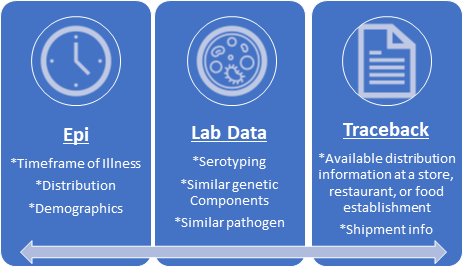
FIGURE 1. The Three Types of Evidence for Foodborne Illness Outbreak Investigations: Epidemiologic ("Epi"), Traceback, and Laboratory Data ("Lab Data") (Credit: FDA)
In 2023, FDA, CDC, and state partners investigated a multistate outbreak of Salmonella Thompson infections linked to diced onions grown and processed in California, resulting in 80 ill people, 18 hospitalizations, and one death reported in 23 states, as discussed in the article, "Multistate Outbreak of Salmonella Thompson Infections Linked to Diced Onions—2023."17
Laboratory, traceback, and epidemiologic evidence indicated onions grown in three specific fields as the source of the outbreak, suggesting that the outbreak strain was present at the farm level, established in the soil, and potentially disseminated through agricultural water. Further processing into diced onions could have also spread and/or amplified the pathogen in the product due to the practices and conditions at the processor.
This investigation highlighted the importance of outreach and education to enhance onion industry food safety practices and prevent future outbreaks. It also emphasized the need for focused research on onion industry practices, including growing, harvesting, curing, processing, packing, and holding.
These 15 publications highlight the contribution of the CORE+EP staff and its partners to current science, examining the distribution and causes of foodborne outbreaks and improving methods to identify and prevent future occurrences.
References
- U.S. Food and Drug Administration (FDA). "About the CORE Network." Current as of January 8, 2024. https://www.fda.gov/food/outbreaks-foodborne-illness/about-core-network.
- Bazaco, M.C., S. Carran, J. Haediges, and B. Weed. "Lessons Learned from Outbreaks: Publications and Reports from FDA's CORE+EP in FY2024." Food Safety Magazine October/November 2024. https://www.food-safety.com/articles/10776-lessons-learned-from-outbreaks-publications-and-reports-from-fdas-coreep-in-fy2024.
- Kirchner, M., A. Palacios, N. Cataldo, et al. "A Binational Sample-Initiated Retrospective Outbreak Investigation of Listeria monocytogenes Infections in the United States and Canada Linked to Enoki Mushrooms Imported from China 2022–2023." Journal of Food Protection 2, no. 88 (January 2025): 100413. https://doi.org/10.1016/j.jfp.2024.100413.
- Bazaco, M.C., C.K. Carstens, T. Greenlee, et al. "Recent Use of Novel Data Streams During Foodborne Illness Cluster Investigations by the United States Food and Drug Administration: Qualitative Review." JMIR Public Health Surveillance 11 (February 2025): e58797. https://doi.org/10.2196/58797.
- Madad, A, M. Vasser, S. Viazis, et al. "An International Outbreak Investigation of Salmonella Enteritidis Infections in the United States and Canada Linked to Peaches—2020." Journal of Food Protection 88, no. 6 (May 2025): 100519. https://doi.org/10.1016/j.jfp.2025.100519.
- McClure, M., M. Kirchner, T. Greenlee, et al. "Investigation of Two Outbreaks of Hepatitis A Virus Infections Linked to Fresh and Frozen Strawberries Imported from Mexico—2022–2023. Journal of Food Protection 88, no. 6 (May 2025): 100505. https://doi.org/10.1016/j.jfp.2025.100505.
- Whitney, B.M., A. Palacios, B. Warren, et al. "An Investigation of Salmonella Senftenberg Illnesses in the United States Linked to Peanut Butter—2022." Foodborne Pathogens and Disease 22, no. 9 (December 2024). https://doi.org/10.1089/fpd.2024.0089.
- Viazis, S., M. Lindsay, J. Cripe, et al. "An Overview of Multistate Outbreak Investigations of Salmonella Infections Linked to Fish and Fishery Products, United States—2012–2021." Journal of Food Protection 88, no. 8 (July 2025): 100566. https://doi.org/10.1016/j.jfp.2025.100566.
- Cataldo, N., C. Schwensohn, M. Kirchner, et al. "An Investigation of an Outbreak of Salmonella Newport Infections Linked to Melons from Southwest Indiana—United States, 2023." Foodborne Pathogens and Disease 22, no. 12 (December 2025): 825–833. https://doi.org/10.1089/fpd.2024.0171.
- Troeschel, A.N., M.C. Buser, A. Winquist, et al. "Investigation of Lead and Chromium Exposure After Consumption of Contaminated Cinnamon-Containing Applesauce—United States, November 2023–April 2024." Morbidity and Mortality Weekly Report 74, no. 14 (April 24, 2025): 239–244. https://www.cdc.gov/mmwr/volumes/74/wr/mm7414a2.htm.
- Tesfai, A., R. Hinnenkamp, B. Weed, et al. "Understanding the Potential Risks of Consuming Raw Morel Mushrooms: Challenges and Lessons Learned from a Recent Outbreak Linked to Raw Morel Mushrooms." Food Protection Trends 45, no. 3 (May 2025): 222–227. https://www.foodprotection.org/publications/food-protection-trends/archive/2025-05-understanding-the-potential-risks-of-consuming-raw-morel-mushrooms-challenges-and-lessons-le/events-meetings/.
- Canning, M., M. Bazaco, B. Weed, et al. "Outbreaks Linked to Melons, United States, 2012–2021." Journal of Food Protection 88, no. 7 (June 2025): 100536. https://doi.org/10.1016/j.jfp.2025.100536.
- Viazis, S., M.C. Bazaco, T. Blessington, et al. "An Overview of Farm Investigation Findings Associated with Outbreaks of Shiga Toxin-Producing Escherichia coli Infections Linked to Leafy Greens: 2009–2021." Journal of Food Protection 88, no. 7 (June 2025): 100542. https://doi.org/10.1016/j.jfp.2025.100542.
- Rose, E.B., M.K. Steele, B. Tolar, et al. "Attribution of Salmonella enterica to Food Sources by Using Whole-Genome Sequencing Data." Emerging Infectious Diseases 31, no. 4 (April 2025): 783–790. https://doi.org/10.3201/eid3104.241172.
- Viazis, S., A. Conrad, A. Palacios, et al. "An Overview of Listeriosis Outbreak Investigations in the United States Linked to Imported Enoki Mushrooms and Associated Regulatory Activities, Research, and Food Safety Knowledge Gaps." Comprehensive Reviews in Food Science and Food Safety 24, no. 5 (September 2025): e70292. https://doi.org/10.1111/1541-4337.70292.
- Federman, S.S., E. Jenkins, C. Wilson, et al. "An Investigation of an Outbreak of Salmonella Typhimurium Infections Linked to Cantaloupe—United States, 2022." Food Control 166 (December 2024): 110733. https://doi.org/10.1016/j.foodcont.2024.110733.
- Graham-Glover, B., E. Pereira, S. Jefferson, et al. "Multistate Outbreak of Salmonella Thompson Infections Linked to Diced Onions—2023." Foodborne Pathogens and Disease (September 2025). https://doi.org/10.1177/15353141251377305.
Brett Weed, Dr.P.H. is a Consumer Safety Officer in the Office of Coordinated Outbreak Response, Evaluation, and Emergency Preparedness (CORE+EP) at the U.S. Food and Drug Administration's (FDA's) Human Foods Program (HFP).
Spencer Carran, Ph.D. is a Biologist at FDA CORE+EP.
Christina K. Carstens, Ph.D. is an Epidemiologist at FDA CORE+EP.
Stelios Viazis, Ph.D. is a Consumer Safety Officer at FDA CORE+EP.
Cary Chen Parker, M.P.H. is a Supervisory Consumer Safety Officer at FDA CORE+EP.