SANITATION
By Yuqian Lou, Ph.D., Director of Food Safety, Sanitation, and Sustainability, PepsiCo Inc., and Abby Snyder, Ph.D., Associate Professor, Food Science, Cornell University
The Limits of 'Dry' Sanitizers in Low-Moisture Environments
Many dry sanitizers still introduce some moisture into the environment, particularly in difficult-to-clean crevices where pathogens can persist
Image credit: dusanpetkovic/iStock/Getty Images Plus via Getty Images
SCROLL DOWN
Low-moisture food facilities increasingly rely on "dry" sanitizers to reduce the risks associated with traditional wet cleaning. However, many dry sanitizers still introduce some moisture into the environment, particularly in difficult-to-clean crevices where pathogens can persist. Without careful application and realistic expectations, the use of dry sanitizers can create a false sense of security while introducing moisture into the very crevices the sanitizers are intended to treat.
The Appeal of Dry Sanitizers
Low-moisture food manufacturers work to minimize water introduction into processing environments. In these facilities, even small amounts of moisture can increase food safety risk. Water mobilizes pathogens that are harbored in equipment crevices and spreads contamination throughout a facility. Water supports microbial growth in areas that otherwise would not, under dry conditions. As a result, many companies have adopted a "treat water like glass" mindset that recognizes how moisture must be tightly controlled and quickly addressed.1
Traditional wet cleaning requires costly downtime for drying before production can safely resume. In many legacy low-moisture facilities, hygienic design limitations further complicate the issue.2 Hollow framework, overlapping surfaces, damaged seals, and difficult-to-clean crevices trap moisture long after equipment appears dry. Once water enters these niches, it creates the conditions that support the growth of environmental pathogens.3
The food industry's use of "dry" sanitizers has expanded. Alcohol-based sanitizers, quaternary ammonium compounds (QACs) in crystalline or wipe form, heat, and gaseous antimicrobial systems are used in sanitation in low-moisture environments to avoid traditional wet washdowns.
Regulatory expectations have contributed to this trend. The U.S. Food and Drug Administration's (FDA's) 2025 Draft Guidance for Industry: Establishing Sanitation Programs for Low-Moisture Ready-to-Eat Human Foods and Taking Corrective Actions Following a Pathogen Contamination Event introduced the concept of a "sanitation break," defined as stopping production to clean and sanitize food-contact surfaces before restarting operations.4 The draft guidance specifically states that in the absence of additional evidence, application of a sanitizer is needed to establish a sanitation break.
This concept has important implications for lot segregation and recall scope. During investigations, the sanitation break may be used to distinguish affected product from product that is considered safe to remain in the market. If a facility cannot demonstrate where contamination control was effectively reestablished, then the amount of product placed at risk can increase significantly. As a result, many companies feel pressure to sanitize surfaces to establish defensible sanitation breaks and limit business exposure. However, in actual investigations, application of a sanitizer alone can be insufficient to support a sanitation break.
This raises important questions about the role of sanitizers in dry facilities. Evidence suggests that cleaning is where much of the microbial reduction happens,5 as discussed in a previous Food Safety Magazine article.6 In practical application, sanitizers deliver more modest reductions in microbial load than what is typically observed in laboratory "coupon" studies.7,8
Hard-to-clean crevices are often identified as examples of why sanitizer application is necessary. However, the same hard-to-clean crevices will be hard to sanitize,2 so the simple application of sanitizer may provide marginal, if any, additional benefit when there are hygienic design gaps and inferior cleaning. Moreover, hard-to-clean crevices will also be the locations most likely to contain residual food soil following cleaning, further reducing the efficacy of sanitization in those areas.
Possible risk introduction during sanitization should also be considered. Traditional wet sanitization—the most commonly employed approach to sanitation breaks across the industry—involves the introduction of significant moisture within food processing environments. There are a range of different dry sanitizers on the market, and product options continue to grow. Some contain a residual amount of water but are formulated to evaporate quickly from exposed surfaces. However, the possibility remains that some moisture can remain in hard-to-clean crevices where air flow may not effectively penetrate, thereby reducing evaporation. The concern is that this residual moisture can increase risk from environmental pathogens.
These tradeoffs should be considered carefully. How effective is the sanitizer treatment at mitigating environmental pathogens in the harborage points most difficult to access in your facility? How much risk enhancement exists due to moisture introduction from sanitizer application and breaching the integrity of the line? Industry should avoid letting the desire to document a sanitation break drive decisions that may inadvertently increase product safety risk. Sanitation programs should be designed to reduce the likelihood of contamination, not simply to create a defensible paper trail after contamination occurs. In most cases, these goals are aligned. However, when they conflict (such as when introducing moisture to apply a sanitizer in a low-moisture environment), the priority is clear.
Facilities should select sanitation approaches based on their ability to minimize overall product safety risk, even if those approaches are less aligned with traditional expectations surrounding sanitizer application.
“Some emerging dry sanitation approaches propose combining a low-moisture antimicrobial mist with a subsequent heat treatment intended to remove residual moisture from the mist while also enhancing microbial inactivation.”

Delivery Methods for Dry Sanitizers
A wide range of sanitizers are currently used in low-moisture food facilities. These treatments vary both in their chemistry and how they are physically applied to surfaces.
Alcohol-Based Sanitizers
Alcohol-based sanitizers are among the most-used interventions in low-moisture food facilities because they evaporate rapidly and are generally perceived as lower-risk alternatives to traditional aqueous sanitizers. However, these products are not moisture-free, as many formulations contain substantial amounts of water. In fact, formulations containing approximately 70 percent alcohol typically achieve greater pathogen inactivation than 100 percent alcohol formulations. One commonly cited reason is that pure alcohol evaporates too rapidly, substantially reducing surface contact time and limiting antimicrobial efficacy. Water slows evaporation and improves protein denaturation, enhancing microbial inactivation. This highlights the central challenge facing low-moisture facilities in sanitation. The same moisture that improves sanitizer performance also increases the risk of introducing and retaining water within hard-to-clean crevices.
QACs
Quaternary ammonium compound (QAC)-based sanitizers are also widely used in low-moisture environments, particularly where residual antimicrobial activity is desired. Some facilities apply dry QAC crystals to floors or other non-food-contact areas. However, in their dry state, QACs have limited antimicrobial activity because the chemistry must be solubilized to function effectively. Some facilities view dry QAC application as an extra precaution, with the rationale that if water is unintentionally introduced, the QAC crystals will dissolve and provide antimicrobial activity. Dry QAC crystal applications are not used on food-contact surfaces.
QACs are applied as aqueous solutions on food-contact surfaces, using wipes, trigger sprays, or spot-treatment applications. One important limitation is that QAC use requires a potable water rinse when organic products are manufactured, depending on the formulation, label instructions, and organic certification requirements. In low-moisture environments, this rinse step may substantially increase risk, limiting the utility of QACs in those environments. As with all sanitizers, QAC application is not a replacement for effective cleaning. Physical removal of residues and contamination remains the primary microbial reduction step in sanitation programs. QAC efficacy will be limited by the presence of dry food residues on surfaces, particularly when sanitizers are applied as spot treatments without prior soil removal.
Heat Treatment
Heat sanitization represents potentially some of the driest sanitizing options available because it can achieve microbial reduction without introducing water. In some cases, heat may actually reduce moisture within the system by promoting evaporation and drying (in the case of dry steam vapor, but not for wet steam). Consequently, some emerging dry sanitation approaches propose combining a low-moisture antimicrobial mist with a subsequent heat treatment intended to remove residual moisture from the mist while also enhancing microbial inactivation.9
Heat may be supplied from an external treatment source or generated by the equipment itself. For example, spray dryers are commonly upstream of dry blending and filling operations. Although the spray dryer chamber undergoes clean-in-place (CIP) treatment, the heated process air is often used afterward during system dry-out. While this heat exposure likely contributes to both drying and some degree of microbial reduction, these dry-out treatments are rarely formally validated as sanitizing interventions. One consideration is that temperature distribution throughout the system is often highly variable. Air temperatures near the heating source at the top of the chamber may be substantial, but temperatures decline significantly at locations farther from the heat source or within recessed cracks. As a result, equipment surfaces may not achieve temperatures sufficient for pathogen lethality. Existing data on thermal inactivation of pathogens on dry equipment surfaces suggest that relatively high temperatures and extended exposure times are often required to achieve appreciable microbial reduction.8 Consequently, assumptions that warm process air alone provides an effective sanitizing treatment may not be justified without direct measurement of surface temperatures throughout the system.
Gas Treatment
The industry has also explored gaseous antimicrobial systems such as chlorine dioxide (ClO₂). Under optimal conditions, ClO₂ can be an effective surface sanitizer. These treatments are attractive in low-moisture environments because they avoid direct liquid application altogether. However, their effectiveness still depends heavily on airflow patterns, surface accessibility, ambient relative humidity, and the absence of shielding residues or protected harborage sites. It is important to note that limited data are available in the scientific literature evaluating the performance of gaseous sanitizers within complex equipment geometries, particularly in commercial or pilot plant environments representative of real low-moisture food facilities.
Given the cost of these treatments, as well as the associated worker health and safety considerations, facilities should carefully evaluate whether the expected benefit justifies their use. Anecdotally, some industry members have reported that gaseous treatments can fail to adequately penetrate hard-to-clean crevices and enclosed niches. This limitation could substantially reduce their practical value, even if treatment of open equipment areas and some diffusion through loose powdered product on surfaces is achievable. Ultimately, gaseous sanitizers could be a useful tool, but they should not be assumed to overcome hygienic design deficiencies or replace the need for effective dry cleaning.
Delivery Methods
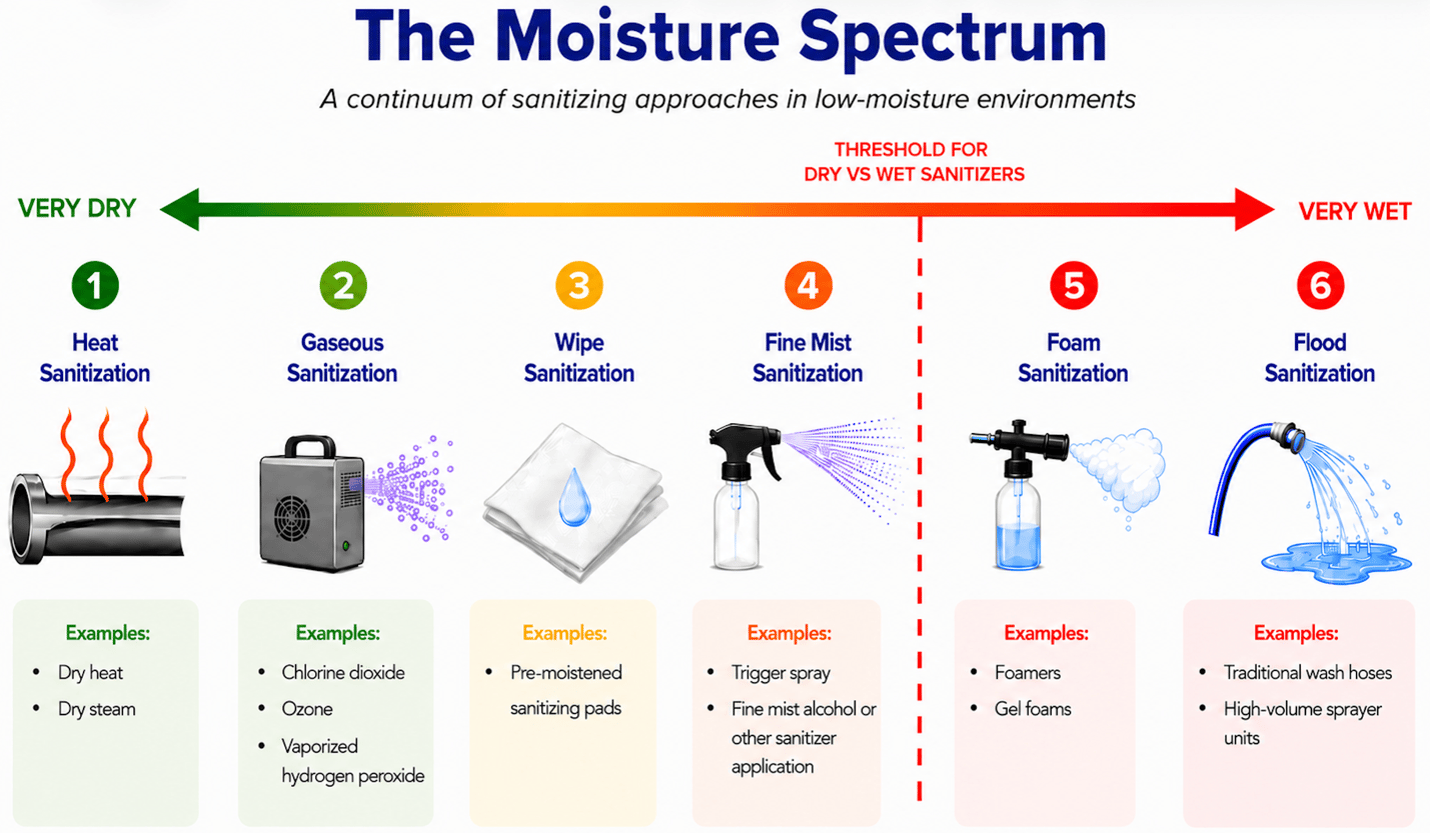
Equally important as the antimicrobial chemistry itself is the delivery method used to apply the intervention. The amount, distribution, and retention of both active sanitizer and residual moisture introduced into a dry environment can vary substantially depending on whether the sanitizer is applied as a wipe, mist, foam, spray, or gas. For example, sanitization using pre-moistened sanitizing pads or wipes provides more controlled liquid application and reduces overspray onto adjacent areas. Fine mist and trigger spray systems generally introduce less moisture than traditional high-volume sprayers. However, some consideration is warranted for moisture introduction, even in these more controlled systems, into cracks, hollow framework, overlapping surfaces, and other non-drainable niches.
Although each of the approaches shown in numbers 1–4 in Figure 1 represent an improvement over conventional flood sanitizing with high-flow sprayers, it should be noted that even controlled aqueous sanitizers can introduce residual water into low-moisture environments.1 In response, some facilities follow sanitizer application with a dry wipe step intended to remove residual liquid from surfaces. Gaseous systems avoid direct liquid application, but face their own limitations related to airflow, diffusion, relative humidity, shadowing, and penetration into enclosed niches. Their performance should be evaluated critically, particularly relative to the microbial reduction already achieved through a thoroughly validated dry cleaning process.
FIGURE 1. Moisture spectrum of sanitizing approaches in low-moisture environments (Credit: Cornell Dry Sanitation Research Advisory Council, generated via ChatGPT 5.5)
“Studies suggest that residual water may remain trapped within enclosed niches for more than two days following moisture introduction. In some facilities, this exceeds the interval between sanitation breaks.”
Residual Moisture from Controlled Wet Sanitizers
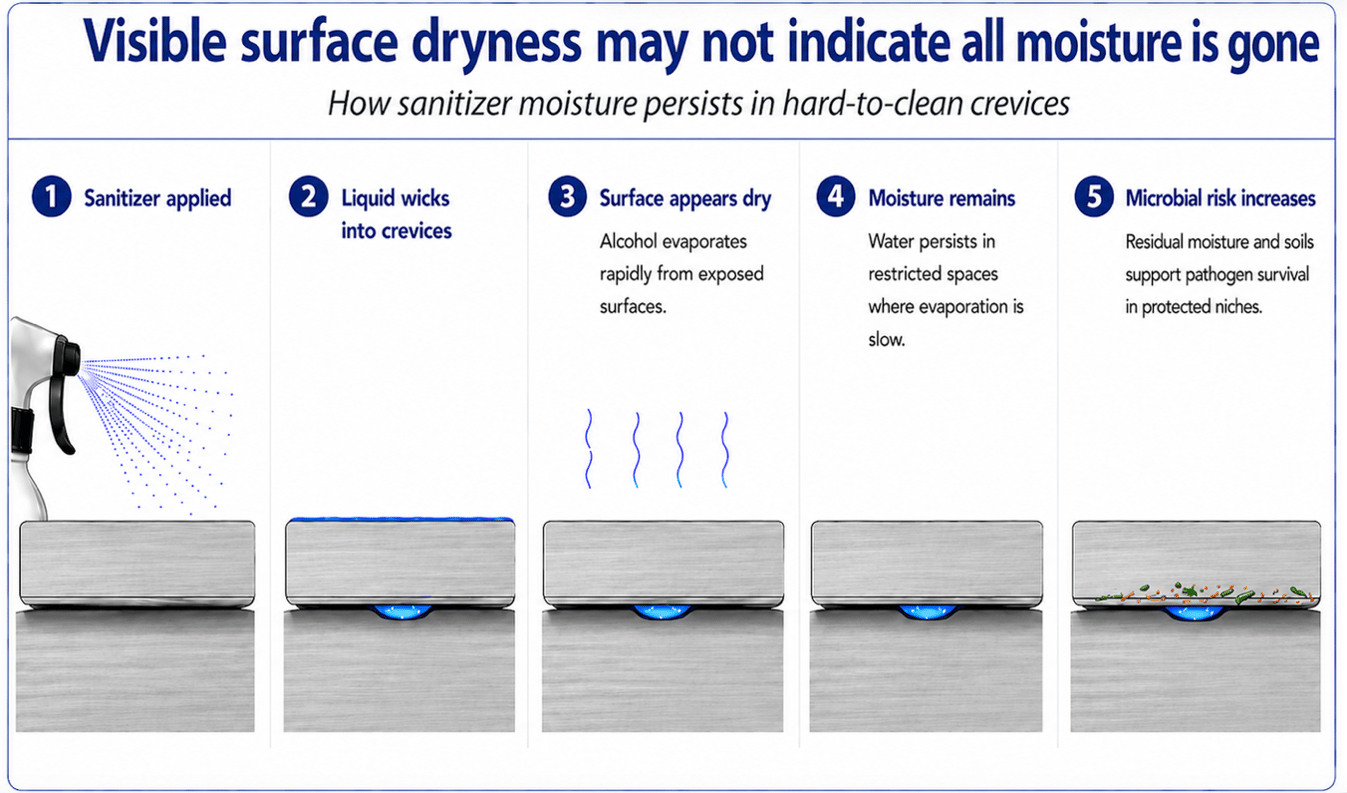
Many sanitizers used in low-moisture food manufacturing environments are classified operationally as "dry" interventions despite containing substantial amounts of water. Alcohol-based sanitizers formulated with ethanol or isopropanol (IPA) typically contain 10–40 percent water because water improves protein denaturation kinetics, antimicrobial efficacy, and formulation stability. While the alcohol fraction evaporates rapidly from exposed surfaces, evaporation dynamics within hard-to-clean equipment crevices are substantially different. Moisture introduced through sanitizing activities may persist within cracks, hollow rollers, threaded fittings, dead ends, framework overlaps, bearing housings, poor welds, and damaged gaskets where restricted airflow and capillary retention slow evaporation.
Data estimating moisture retention within equipment crevices are limited, but related studies suggest that residual water may remain trapped within enclosed niches for more than two days following moisture introduction. In some facilities, this exceeds the interval between sanitation breaks. Once food residues subsequently enter these partially hydrated crevices, a sticky or caked harborage site capable of entrapping microorganisms and supporting their growth may develop. In this case, equipment surfaces may appear visually dry while residual moisture remains trapped within inaccessible crevices that are difficult to clean, inspect, or dry effectively.
This raises two important technical questions for sanitarians in low-moisture environments. First, can repeated application of controlled wet sanitizers progressively hydrate microbial harborage sites over time? Again, direct experimental studies evaluating cumulative moisture retention from repeated sanitizer application are limited. However, the mechanism is plausible and consistent with known moisture migration behavior in enclosed geometries. Small volumes of liquid repeatedly introduced into non-drainable niches where evaporation rates are slow should be avoided in dry environments. This concern is particularly relevant in facilities with legacy equipment and hygienic design deficiencies that prevent drainage and complete drying. Hygienic design principles that eliminate dead ends, improve drainability, minimize horizontal ledges, and reduce liquid retention volumes are key when controlled wet sanitizers are used in low-moisture environments.
A second question is whether low levels of retained moisture within these niches can alter pathogen survival dynamics. Salmonella can persist for prolonged periods in low-water-activity environments while remaining metabolically responsive to transient moisture exposure.3 Food soil in these crevices further protects Salmonella from the bactericidal effect of sanitizers applied to those surfaces. Environmental investigations in low-moisture food facilities have repeatedly associated product contamination with moisture events. Consequently, the retention of moisture within inaccessible crevices that cannot be effectively cleaned, inspected, or dried remains a risk (Figure 2).
FIGURE 2. Moisture retention within inaccessible crevices remains a risk (Credit: Cornell Dry Sanitation Research Advisory Council, generated via ChatGPT 5.5)
Takeaway
Sanitizing does not replace a validated clean. In low-moisture environments, the primary microbial reduction step remains effective cleaning, which is supported by hygienic design. Sanitizers may offer a marginal benefit to microbial reduction on already clean, accessible surfaces, but they cannot reliably penetrate soils or inaccessible harborage sites. These same crevices are challenges to dry physical cleaning procedures. Overreliance on dry sanitizers without sufficient attention to moisture management, equipment drainage, and cleaning may unintentionally increase risk rather than reduce it. Ultimately, the effectiveness of any sanitation program in a low-moisture facility depends less on the sanitizer chemistry and more on the holistic process that addresses difficult-to-clean crevices.
Best practices include:
- Avoid flooding surfaces
- Use targeted application instead of broad spraying
- Improve airflow and drying
- Verify drying before startup, particularly in hard-to-clean niches
- Prioritize hygienic design improvements
- Eliminate harborage sites where moisture does not drain.
Acknowledgment
This work was supported in part by a grant from Dairy Management Inc. to Dr. Abby Snyder.
Note
The views expressed in this manuscript are those of the authors and do not necessarily reflect the position or policy of PepsiCo Inc.
References
- Thorson, K. and A. Snyder. "In Dry Processing Environments, Treat Water Like Glass." Food Safety Magazine April/May 2026. https://digitaledition.food-safety.com/april-may-2026/column-sanitation/.
- Mirdamadi, N. and A. Snyder. "In Dry Environments, Wet Sanitation Isn't the Answer—It's the Issue." Food Safety Magazine February/March 2026. https://www.food-safety.com/articles/11162-in-dry-environments-wet-sanitation-isnt-the-answerits-the-issue.
- Slaughter, C., S. Chuang, D. Daeschel, L. McLandsborough, and A.B. Snyder. "Moisture Matters: Unintended Consequences of Performing Wet Sanitation in Dry Environments." Applied and Environmental Microbiology 92, no. 5 (May 2026). https://journals.asm.org/doi/pdf/10.1128/aem.02365-25.
- U.S. Food and Drug Administration (FDA). Draft Guidance for Industry: Establishing Sanitation Programs for Low-Moisture Ready-to-Eat Human Foods and Taking Corrective Actions Following a Pathogen Contamination Event. January 2025. https://www.fda.gov/regulatory-information/search-fda-guidance-documents/draft-guidance-industry-establishing-sanitation-programs-low-moisture-ready-eat-human-foods-and.
- Daeschel, D., L. Chen, C. Zoellner, and A.B. Snyder. "A Simulation Model to Quantify the Efficacy of Dry Cleaning Interventions on a Contaminated Milk Powder Line." Applied and Environmental Microbiology 91, no. 5 (May 2025). https://journals.asm.org/doi/pdf/10.1128/aem.02086-24.
- Bogart, N. and A. Snyder. "The Real Microbial Reduction Step is Cleaning." Food Safety Magazine June/July 2026. https://www.food-safety.com/articles/11556-the-real-microbial-reduction-step-is-cleaning.
- Jiao, Y., J. Baker, C. Slaughter, D. Daeschel, and A.B. Snyder. "Variable Fluid Mechanics Explain Why Static Efficacy Tests Overestimate Sanitizer Performance Against Listeria." May 2026. BioRxiv. https://doi.org/10.64898/2026.05.13.724842.
- Baker, J., Y.S. Rana, L. Chen, M.A. Beary, V.M. Balasubramaniam, and A.B. Snyder. "Superheated Steam Can Rapidly Inactivate Bacteria, But Manual Operation of Commercial Units Resulted in Limited Efficacy During Dry Surface Sanitization." Journal of Food Protection 88, no. 3 (February 2025): 100461. https://www.sciencedirect.com/science/article/pii/S0362028X25000134.
- Seshadrinathan, S., V.M. Balasubramaniam, and A.B. Snyder. "Antimicrobial Mist Pretreatment for Enhancing Superheated Steam Efficacy in Inactivating Enterococcus faecium NRRL B-2354 on Dry Food Processing Surface." Food Microbiology 135 (April 2026): 104956. https://www.sciencedirect.com/science/article/pii/S0740002025002369.
Yuqian Lou, Ph.D. is an R&D Fellow and Director of Food Safety, Sanitation, and Sustainability at PepsiCo. He earned his Ph.D. from The Ohio State University and B.S. and M.S. degrees from Tianjin University of Science and Technology. Dr. Lou provides leadership for the Cornell Dry Sanitation Advisory Council.
Abby Snyder, Ph.D. is an Associate Professor at Cornell University. She earned a Ph.D. from Cornell University and B.S. and B.A. degrees from The Ohio State University. She directs the Dry Sanitation Advisory Council, and her research group works with industry to understand and improve sanitation practices.