DATA CULTURE
By Barabara Kowalcyk, Ph.D., M.A., Associate Professor, Department of Exercise and Nutrition Sciences, George Washington University and Director, Food Policy Institute, Milken Institute School of Public Health
Data Culture: A Critical Preventive Control for Food Safety
The real challenge today is not simply having access to data; it is making sense of it

Image credit: gorodenkoff/iStock/Getty Images Plus via Getty Images
SCROLL DOWN
Managing food safety is becoming more complex every day, from increasingly global food supply chains to shifting food–hazard risk profiles to emerging pathogens. A perusal of recent news quickly demonstrates this: imported spices contaminated with lead, Clostridium botulinum in infant formula, the spread of New World Screwworm, and the list goes on. At the same time, resources are constrained. Government agencies charged with food safety responsibilities have experienced significant budget cuts, leading to staff layoffs, reduced inspections, delayed regulations, and scaled-back surveillance at the federal, state, local, tribal, and territorial levels. Shifting government priorities, ranging from new tariffs to delays in the traceability rule to reduced extension resources, create operational challenges for the food supply chain and the industries that support it (e.g., sanitation services, testing laboratories, equipment manufacturers, technical providers). All of this increases the risk of system failures, placing a substantial burden not only on consumers, but also those responsible for responding to those failures, including food producers, government agencies, non-governmental organizations, and academics. Clearly, food safety risks are not abating, but resources are.
While the current situation is becoming more complex, it is not new. For decades, the food safety community has recognized that limited resources make it necessary to prioritize the management of food safety risks. In 2010, the National Academies of Sciences, Engineering, and Medicine issued a report1 calling for a risk-based food safety system, and provided a framework for such a system. In particular, the authors defined a risk-based food safety system as one that is proactive and data-driven, grounded in risk analysis, and designed to maximize public health impact. Data, in particular, was called out as being foundational to such an approach, but a lack of data-sharing, limited analytical expertise, and insufficient infrastructure limited its utilization.
In the 16 years since the publication of that report, recognition of the critical role of data in managing food safety risks has grown, particularly in the new age of artificial intelligence (AI). There are more data streams, digital tools, and dashboards than ever before, but more data does not necessarily lead to improved food safety. Data only have value when used to derive insights that drive action. In fact, most food safety failures do not happen because of a lack of data but rather because the data were unused, misused, mistrusted, or ignored.
The Real Risk: Data Without Meaning
The real challenge today is not simply having access to data; it is making sense of it. Data are often fragmented across systems and viewed as a compliance requirement rather than a strategic asset for risk prevention. Take temperature logs as an example. Refrigerator and freezer temperatures are often critical control points for food safety and are regularly recorded to ensure compliance. The logged temperatures (i.e., data) may show that the temperature stayed within safe limits, giving the impression that the food was stored safely. However, if the instrument was not properly calibrated or the employee did not accurately record the temperature, then the data could be misleading. This, in turn, could pose a significant risk.
One of the clearest examples of the "fragmented data" problem is the 1986 Space Shuttle Challenger tragedy. On the day of the launch, the outside air temperature was 36 °F, which was 15 °F colder than previous launches.2 This was important because the resiliency of the rubber seals used in the solid rocket boosters (i.e., O-rings) was impacted by temperature. In fact, data showed that only 15 percent of flights with O-ring temperatures above 66 °F had O-ring distress compared to 100 percent of flights with O-ring temperatures at or below 63 °F. NASA had been aware of problems with the O-rings but had not carefully analyzed the data; instead, the agency concluded that, while the seal design was faulty, it was still safe to fly. As a result, 73 seconds after takeoff, the Space Shuttle Challenger exploded, killing the seven people aboard. NASA ignored the context around the data, creating a blind spot and a lost opportunity to prevent the tragedy.
“Organizations that prioritize the transformation of accurate, consistent, and validated data into meaningful insights have a positive data culture.”

In fact, most system failures occur in data-rich environments. If the data are inaccurate or incomplete, then the results from any analysis will also be inaccurate or incomplete, which is commonly referred to as "garbage in, garbage out." Quality of inputs impacts the quality of outputs; poor-quality inputs undermine reliability and usability, creating more work. The quality of inputs is not the only thing that matters; the process of turning those inputs into something of value matters, as well. Accurate and valuable data are worthless if they are managed, analyzed, or interpreted incorrectly—in other words, "value in, garbage out." For effective decision-making, we need high-quality data that are properly collected, analyzed, interpreted, and acted upon; basically, "value in, value out." When this happens, the value of data are fully actualized, and meaningful results are used to inform decision-making and reduce risk.
Organizations that prioritize the transformation of accurate, consistent, and validated data into meaningful insights have a positive data culture. Such organizations do not blindly follow data, but instead seek insights that are reliable. Critical thinking and data-driven problem-solving are actively encouraged. A strong emphasis is placed on data quality, with trends being reviewed routinely rather than reactively. Data are treated as evidence that prompts action, rather than a threat. Investments extend beyond technology to include people and processes, reflecting the understanding that tools such as digitization technologies, dashboards, and AI do not create data culture, but rather support it. Most importantly, a positive data culture is recognized as a powerful tool for preventing risk.
A Data Culture Framework
Every organization has a data culture—i.e., shared values, behaviors, and practices around the use of data in decision-making. It cannot be overstated that data culture is not about data availability, analytics maturity, or the adoption of technologies like AI. Using such tools without a positive data culture will only lead to faster data collection with the same blind spots and lost opportunities for prevention. Technology should amplify data culture, not be the foundation for it.
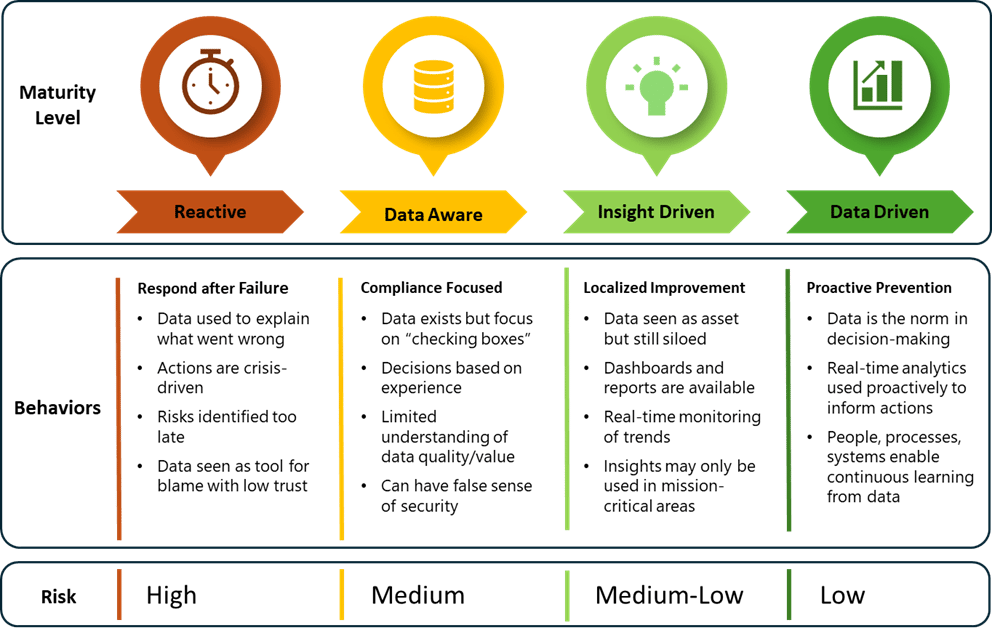
There are four main types of data culture:
- In a reactive data culture, decisions are rarely driven by data, even though it may be collected. An example of this would be reviewing temperature logs at the end of the day and reacting to violations.
- In a data-aware culture, data are collected, but the focus tends to be on checking boxes (i.e., compliance-driven) rather than using data to drive insights or improvements. An example of this would be ensuring that temperature logs are complete and accurate, but not reviewing trends to identify unsafe temperatures.
- In an insight-oriented data culture, data are seen as an asset and used to inform decisions, but may be siloed or only used in mission-critical areas. An example of this would be monitoring temperature logs in real time and implementing corrective actions when patterns indicate risk.
- In a data-driven culture, data are integrated into every level of decision-making and used to innovate and continuously improve. People, processes, and systems enable effective and efficient use of data, and insights drive proactive change. An example of this would be using predictive analytics to adjust and optimize temperature controls.
To improve food safety, we must shift from being data-aware to being truly data-driven. Such transformations are not instantaneous, but rather a progressive journey in which organizations build capabilities, behaviors, and trust in data over time (Figure 1). While several models exist, the BARC Data and AI Culture Framework3 identifies six components of a data-driven culture that, when intentionally developed and aligned, can support this evolution and ultimately improve food safety outcomes and protect public health.
FIGURE 1. Data maturity levels, associated behaviors, and risk levels (Image credit: B. Kowalcyk)
A Data-Driven Culture: Six Reinforcing Components
A data-driven culture starts with strong data leadership, where leaders view data as an asset and champion its value across every level of the organization. Such leaders actively communicate how data, from temperature logs to laboratory test results to third-party audits, support food safety and business objectives, and they model the use of data in decision-making. Strong data leadership fosters an environment that encourages data-sharing, attention to early signals, and critical evaluation of data and assumptions. Near-misses are openly discussed without blame, recognizing that fear can suppress reporting and undermine culture. Strong leaders recognize that technology is not enough; they invest in data literacy and skills development, so their teams are empowered to effectively turn data into actionable insights. Importantly, they do not use data to confirm decisions they have already made, but instead let evidence drive timely, informed actions that prevent food safety risks and protect public health.
To ensure that the right data are being used in the right way to drive the right outcomes, a data strategy is needed. A data strategy is basically a roadmap for deriving insights and value from data. It should always start with a clear and measurable objective that is driven by the decisions that must be made. Is the goal to reduce critical control point deviations by a certain percentage? Reduce the rate of reprocessing due to microbial contamination? Measure the effectiveness of a training program? Prioritize inspection resources? Each of these objectives would require different types of data and different approaches to collecting, managing, governing, utilizing, and communicating that data.
Importantly, the data strategy should prioritize ethical data use—i.e., using data methods that are valid, relevant, and appropriate. Addressing and mitigating potential bias (i.e., a built-in "slant" that influences the results of data analysis) is crucial to ensuring that a data strategy drives value. For example, when estimating contamination rates, sampling only from locations unlikely to contain contamination or using less sensitive methods can introduce bias, making a food safety program appear more effective than it is. All data have some level of bias, which is why it is important to be transparent about how data are collected, managed, and analyzed. This includes specifying the assumptions of the statistical methods used, the limitations, and the possible sources of bias so that data are interpreted within the proper context. Without a clear data strategy, data-collection activities amount to record-keeping rather than meaningful analysis.
Of course, developing a data strategy is only the beginning. Data governance sets the rules, standards, and procedures for data ownership, quality, management, access, storage, protection, use, and decision-making. A clear governance framework ensures that data are complete, correct, and reliable. It also establishes data standards that ensure data are collected and interpreted in a consistent way; basically, it gets everyone speaking the same language. This is very important for comparing and combining data. For example, imagine that laboratory testing data is being combined. What does a positive mean? Does the interpretation depend on how the test was conducted? (It probably does.) Without some agreed-upon standards, it would be difficult to make sense of the data.
A clear governance framework also outlines who owns the data, who can access the data, and how they are permitted to access it. Many are reluctant to share data because of a lack of trust in how others will use and communicate the data, especially if there are concerns about blame from within the organization, regulatory enforcement actions, or negative publicity. This lack of trust leads people to withhold data, ignore warnings, and/or delay actions, which can adversely affect food safety and cause unnecessary illnesses. The goal of data governance is to make sure data are accurate, complete, secure, accessible, trustworthy, and understandable.
Data literacy is critical to empowering the translation of data into meaningful insights and actions that prevent contamination and, when failures do occur, to enable faster, smarter responses. Everyone uses data every day to make decisions, whether it is deciding to bring an umbrella because there is a 70 percent chance of rain, using step counts to adjust habits, or assessing if the information they are reading is inaccurate or biased. In food safety, the ability to interpret and act on data is especially critical, as it can mean the difference between preventing contamination and responding to it. Not everyone needs to be a data scientist, but everyone does need to be able to read, write, analyze, communicate, and reason with data. This includes interpreting trends, identifying anomalies, and understanding the context and limitations of data. Everyone from the frontline worker to top-level management needs to be able to critically evaluate data quality and relevance, interpret trends and patterns, and effectively communicate data insights. Without these skills, early warning signals can be overlooked, problems can escalate, and a false sense of safety can develop, putting everyone at risk. In sum, cultivating data literacy empowers prevention, especially when it is coupled with strong subject matter expertise.
“When people have access to accurate, contextualized data, they are more likely to trust the information and the decisions based on it.”
Data access and usability are central to building a strong data culture. This does not mean giving everyone unrestricted access to all data; rather, it means ensuring that relevant data are available to those that need it, along with the tools and training required for effective use of that data. For example, frontline workers may only need access to the real-time microbial data needed to take corrective actions, while food safety managers may need access to historical data so they can track trends across shifts or locations.
Improving data accessibility and usability, sometimes referred to as data democratization, also requires removing barriers and breaking down silos. Ideally, data would be transparent, with users knowing what data exists, what it represents, and the context in which it was collected. Data dictionaries and metadata are critical to such transparency, as they provide clear definitions and context for each data point, ensure consistency, and prevent misinterpretation. While there are often significant fears around making data more accessible and usable, the return on investment is significant. When people have access to accurate, contextualized data, they are more likely to trust the information and the decisions based on it. This translates to faster responses to risks, improved compliance, stronger accountability, and fewer food safety missteps.
Data alone are meaningless unless they are shared, understood, and acted upon. In a strong data culture, data communication and engagement go far beyond simply sharing numbers or reports. They involve creating an environment where insights are not only visible but also proactively used to prevent risks. Effective data communication demonstrates the value of data and its potential to improve food safety. Active engagement means empowering team members to interpret trends, ask questions, investigate anomalies, and take timely action based on the insights. As a result, data literacy improves, fostering responsible data use and building trust.
Breakdowns in data communication and engagement can delay action, undermine intervention efforts, and erode confidence in food safety. Many high-profile food safety failures illustrate these consequences, whether it is missing early warning signs in testing and monitoring data that lead to an outbreak or recalled products remaining on store shelves for weeks. Even when the necessary data exists, its impact depends on how well it is communicated, interpreted, and acted upon within and across stakeholder groups. Gaps in translation and understanding are not uncommon, since many communication and data teams are not subject matter experts, and many subject matter experts are not fluent in data analysis or communication best practices. Without effective integration across these roles, compliance can weaken, response times can be delayed, trust can erode, and public health may ultimately be compromised.
Conclusion
Data by itself does not prevent food safety failures—people do. Think about your data culture. Do you collect data out of habit? Do you trust your data enough to act on it? Do you view data as a strategic asset? Do you make data accessible? Do you empower your team to use data to drive insights and continuous improvement? If you did not answer yes, then adopt a continuous improvement approach toward changing your data culture. Start small and build momentum. Champion data culture initiatives and use change management to address resistance. Focus on relevant metrics, rather than collecting more data.
Foster data literacy through training and support, and encourage a test-and-learn mindset. Integrate data into daily workflows and encourage data-sharing. Embrace storytelling and celebrate wins. It may not be easy, but in the end, it is worth the investment. A positive data culture is critical to a positive food safety culture. Both play a critical role in reducing food safety risks and preventing illnesses and deaths.
In a resource-constrained world, a strong data culture may be our most effective preventive control.
Acknowledgements
The author would like to thank Janet Buffer, Chris Jordan, Joelle Mosso, Gustavo Reyes, Brendan Ring, and Katie Stolte-Carroll for their constructive feedback on this article.
References
- National Academies of Sciences, Engineering, and Medicine (NASEM). "Enhancing Food Safety: The Role of the Food and Drug Administration." 2010. https://www.nationalacademies.org/publications/12892.
- National Aeronautics and Space Administration (NASA). "Report of the Presidential Commission on the Space Shuttle Challenger Accident, Volume I, Chapter 3." 1986. https://www.nasa.gov/history/rogersrep/v1ch3.htm.
- Bange, C. "Data culture: Definition, Challenges, and Measures." BARC. https://barc.com/data-culture/.
Barbara Kowalcyk, Ph.D., M.A., is an Associate Professor in the Department of Exercise and Nutrition Sciences and the Director of the Food Policy Institute at George Washington University's (GW's) Milken Institute School of Public Health. She also has an appointment in the U.S. Department of Environmental and Occupational Health and is a fellow with the Sumner M. Redstone Global Center for Prevention and Wellness.
Dr. Kowalcyk's research spans a range of topics related to food safety and infectious foodborne disease, and their intersection with nutrition security. She has extensively used epidemiologic methods, data analytics, and risk analysis to assess food safety risks and potential intervention strategies in both the U.S. and the Global South. Prior to joining GW in 2023, Dr. Kowalcyk was faculty at Ohio State University with appointments in the Department of Food Science and Technology and the Department of Environmental Health Sciences, and directed the Center for Foodborne Illness Research and Prevention (CFI), a nonprofit organization she co-founded in 2006. Prior to joining OSU, she was a senior food safety and public health scientist at RTI International and a research assistant professor in the Department of Food, Bioprocessing, and Nutrition Science at North Carolina State University.
Dr. Kowalcyk holds a B.A. degree in mathematics from the University of Dayton, an M.A. degree in Applied Statistics from the University of Pittsburgh, and a Ph.D. in Environmental Health from the University of Cincinnati. She has served on many national committees, including two National Academy of Sciences committees and her current appointment to the U.S. Food and Drug Administration's (FDA's) Science Board.