PACKAGING
By Min DeGruson, Ph.D., Associate Professor and Program Director in Packaging, University of Wisconsin–Stout
Lifecycle Assessment in Food Packaging: What Food Industry Professionals Need to Know
LCA helps packaging professionals move beyond assumptions and make more informed decisions about environmental trade-offs
Image credit: Jitti Narksompong/iStock/Getty Images Plus via Getty Images
SCROLL DOWN
Food companies are under growing pressure to make packaging more sustainable. Customers are asking for alternatives to conventional materials, brand owners are setting ambitious environmental goals, and regulators are placing greater emphasis on packaging waste, recyclability, and producer responsibility. At the same time, food manufacturers cannot lose sight of packaging's primary function: to protect and preserve the product.
This is where lifecycle assessment (LCA) becomes especially valuable. The food industry is actively exploring ways to improve packaging recyclability, reusability, and compostability, but choosing among these options is rarely straightforward. Is one format inherently better than another from an environmental perspective? Will switching from a fiber-based package to a plastic-based one actually reduce impacts? A recyclable single-layer or multi-layer monomaterial pouch, for example, may appear preferable to a multi-layer pouch that is not recyclable. However, if the recyclable pouch shortens shelf life or increases product damage rate, that apparent advantage may disappear. Packaging decisions influence raw material use, manufacturing, transportation, product protection, shelf life, and end-of-life outcomes. Without a broader systems perspective, companies may shift environmental burdens from one stage to another rather than truly reducing them.
What is Lifecycle Assessment?
In simple terms, LCA is a systematic analysis used to quantify resource use and the impacts on the environment and human health associated with a product or system over its entire lifecycle.1 International standards ISO 14040 and ISO 14044 provide the framework and guidance for conducting LCA studies.1,2 In packaging, this means looking beyond the visible container to evaluate what happens from raw material extraction through manufacturing, distribution, use, and end of life. By taking this broader perspective, LCA evaluates the environmental footprints (EFP) and impact in different phases.
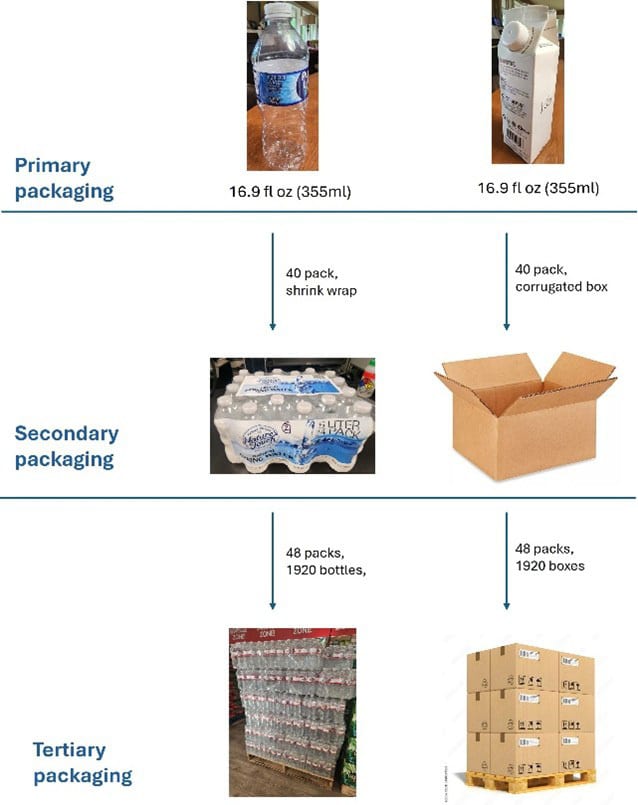
A familiar example is bottled water (Figure 1). An LCA does not begin when a consumer picks up the bottle. It begins upstream, with fossil resources used to produce polyethylene terephthalate (PET) resin for the bottle, polypropylene (PP) for the cap and label, and polyethylene (PE) for the shrink film. It includes bottle manufacturing, filling, case packing, palletization, transportation to retail, consumer use, and what happens after disposal or recovery. While comparing different packaging formats for the same product, the whole packaging system needs to be considered (Figure 2). This wider view helps explain why packaging decisions that seem straightforward at first can become much more complex when analyzed across the full lifecycle.
FIGURE 1. LCA different phases and example for a bottled water (Image credit: M. DeGrusen)
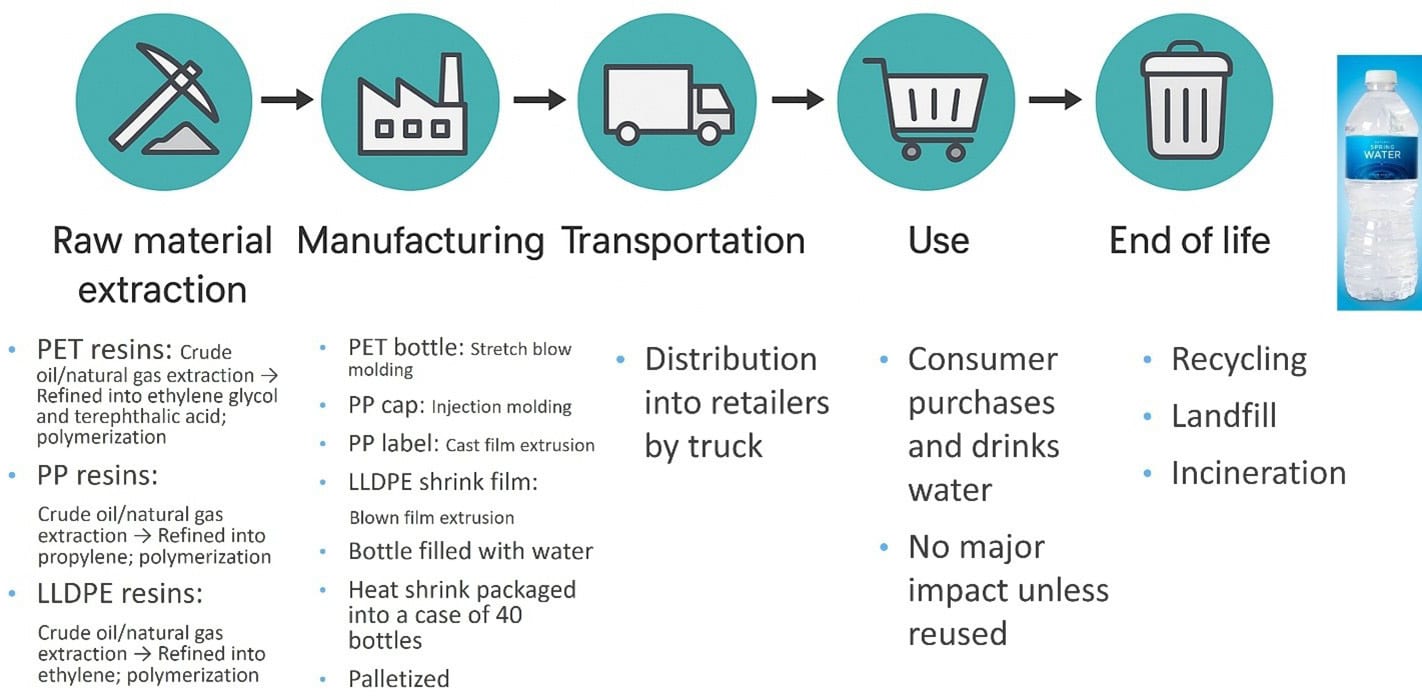
FIGURE 2. Representation of packaging systems (primary, secondary, and tertiary) to deliver water (Image credit: M. DeGrusen)
Reasons to perform an LCA study
Companies run LCA studies for many reasons, but most begin with the same need: to move beyond assumptions and get a clearer picture of a package's environmental effects. In packaging, LCA is often used to determine whether one product or system is environmentally preferable to another that serves the same function. This is especially relevant when companies want to compare food packaging formats, materials, or end-of-life scenarios, or when they intend to make a comparative assertion to the public about the superiority or equivalence of one option vs. another. Comparative packaging studies remain one of the most common applications of LCA, particularly in food and beverage systems.3
An LCA can provide a first impression of the environmental profile of a package, helping teams understand where impacts occur across the lifecycle and where improvements may be possible. It is also widely used for company-internal innovation, such as evaluating product redesign, supporting product development, or assessing the environmental implications of a technical change before it reaches the market. In other cases, the motivation is broader than a single company. Sector-driven studies can help industries evaluate the environmental performance of common materials or formats, such as aluminum, plastics, or fiber-based systems, to guide industry-wide innovation and investment.4
LCA is also becoming increasingly important for regulatory and reporting purposes. As extended producer responsibility (EPR) programs expand, producers are being asked to provide more robust environmental information about packaging systems. Oregon's packaging EPR framework is especially notable because it directly references lifecycle evaluations in connection with producer incentives and reporting, signaling that LCA is becoming not only a design and communication tool, but also a compliance and policy tool.
Steps to Conduct an LCA Study
As mentioned previously, ISO 14040 and 14044 provide the framework and guidance to conduct LCA. The main steps of an LCA study include:
- Defining goal and scope, including functional unit and reference flow
- Defining how to collect all the needed inventory data
- Aggregating this data into an impact assessment methodology
- Conducting an interpretation of the results.
“It is important to remember that one LCA cannot answer every question at the same time … LCA is a circular process.”

Define the Goal
Defining the goal is to establish why the LCA is being conducted and how the results will be used. A company may conduct an LCA to compare packaging alternatives, identify weak points in an existing system, support design changes, establish a baseline for reporting, or communicate sustainability information internally or publicly. Defining the goal early matters because it shapes the level of detail required, the audience for the study, and which environmental indicators are most relevant. A study created for internal package development may look different from one intended to support external communication. It is important to remember that one LCA cannot answer every question at the same time. Instead, identify goals that are more narrow than vague, knowing that changes can be made later. LCA is a circular process.
Defining Scope
Scope includes the product or process being studied, the system boundaries, the packaging levels included, the geographic context, the environmental indicators selected, allocation methods, and assumptions or limitations. In packaging, scope also means deciding whether the analysis covers only primary packaging or includes secondary and tertiary systems as well. Those choices affect the outcome significantly. A change that reduces impact at the primary package level could increase transportation or warehouse impacts if it changes cube efficiency or palletization.
Function, Functional Unit, and Reference Flow
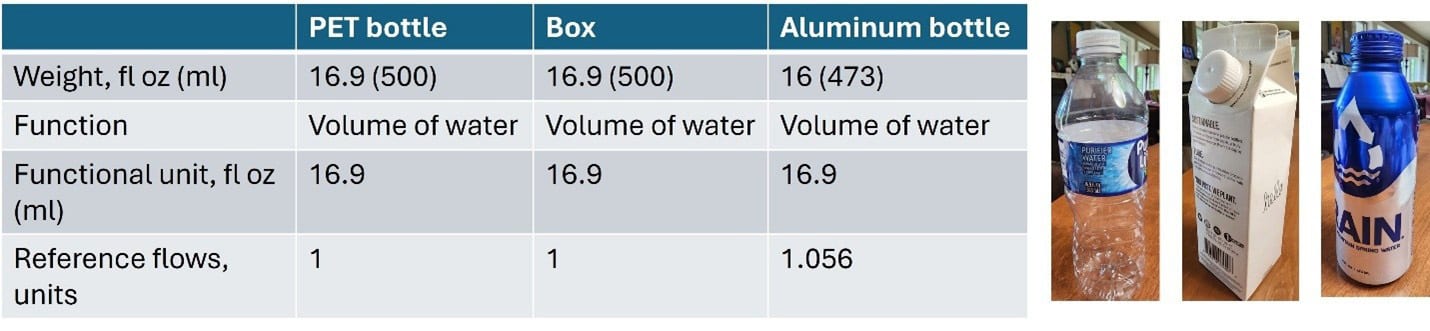
For food packaging professionals, one of the most important concepts in LCA is the functional unit. The functional unit defines what exactly is being delivered and allows an "apples-to-apples" comparison between packaging systems. In other words, the comparison should not be "one pouch vs. one tray" or "paper vs. plastic." It should be based on the amount of packaging required to deliver a defined quantity of food in usable condition. The reference flow is defined as a measure of the process outputs in each product system that are required to fulfil the function expressed by the functional unit. For the example of the water packaging above, the function and functional unit is 16.9 fluid oz. of water delivered to the consumer. The reference flow is 1 for bottled water but 1.056 for an aluminum bottle (Figure 3).
FIGURE 3. Function, functional unit, and reference flow of an LCA study for water packaging lifecycle inventory (LCI) and lifecycle impact assessment (LCIA) (Image credit: M. DeGrusen)
Lifecycle Inventory (LCI) and Lifecycle Impact Assessment (LCIA)
The LCI stage collects the data needed to build the model: materials, energy inputs, manufacturing emissions, transportation distances, use-phase considerations, and end-of-life pathways such as recycling, landfilling, or incineration. These data may come from primary sources, such as direct measurements from operations, or secondary sources, such as established databases.
The LCIA stage then translates those inventory flows into potential environmental impacts. LCIA aims to make the results of LCI more understandable and more manageable concerning human health, the availability of resources, and the natural environment. Some examples of lifecycle indicators used in LCA software include fossil fuel use (MJ-eq deprived), water consumption (with scarcity) (m3 world-eq), mineral resources use (kg deprived), global warming potential (with CO2 uptake) (kg CO2 eq), human impact (midpoint) (CTUh), freshwater ecotoxicity (CTUe), and freshwater eutrophication (kg PO4-eq).5
Interpretation
Interpretation is the phase of LCA in which results, assumptions, and methodological choices are evaluated before conclusions are drawn. Since LCA is iterative, interpretation may lead to refinements in the goal, scope, or model. The first step is evaluating the results through consistency and completeness checks. Consistency asks whether the methods, assumptions, models, and data match the goal and scope of the study, while completeness confirms that all relevant information has been included and that no major gaps are influencing the findings.
The next step is analysis of the results. Contribution analysis helps estimate how much each process, lifecycle phase, component, or packaging level contributes to total impacts, making it possible to identify environmental hotspots. Robustness analysis examines whether the conclusions remain valid when process data, model choices, or assumptions vary. A sensitivity test examines how changes in key assumptions affect the study results and helps identify which inputs have the greatest influence; for example, varying package mass, scrap rates, transport distances, and end-of-life assumptions can show how these parameter changes alter outcomes across multiple impact indicators. Results should then be communicated in a way that fits the audience, using clear visuals, real-world examples, and relatable language, since the level of detail and emphasis will differ for internal decision-making vs. public-facing claims, or for engineers vs. environmental, social, and governance (ESG) managers. Results should also be framed carefully within standards such as ISO 14040/14044 and the Federal Trade Commission (FTC) Green Guides, with enough context, disclaimers, and review to avoid greenwashing.
LCA Software
Lifecycle assessment software generally falls into two categories: full LCA software and streamlined LCA tools. Full LCA software is intended for comprehensive studies and offers the flexibility needed to conduct assessments consistent with ISO 14040 and ISO 14044. These programs provide access to large databases, detailed modeling options, and multiple impact assessment methods. In contrast, streamlined LCA tools are typically developed for a specific sector, such as packaging, and are designed to make the analysis faster and easier to perform. They do this by using predefined assumptions, industry-average data, and simplified workflows that reduce the number of choices users must make. As a result, streamlined tools are especially useful for screening studies, package comparisons, and early-stage design decisions.
“Research has shown that food waste often carries a far greater environmental burden than the package itself, meaning that a package with a slightly higher footprint may still be the better choice if it prevents product loss.”
A number of proprietary full-LCA software programs are available. In addition to these commercial tools, some packaging suppliers have developed their own proprietary LCA platforms to help customers evaluate packaging options and communicate environmental performance. Together, these tools illustrate how LCA is being used across the packaging value chain, from rigorous, full-scale studies to faster, decision-oriented assessments tailored to industry needs.
Cautions and Limitations
Lifecycle assessment is a valuable decision-support tool, but it is not a perfect or universal answer. Results can change depending on the software, database, assumptions, and impact methods used. In one packaging study, different LCA software programs produced conflicting rankings for the same packaging options, and in some cases the reported impacts differed dramatically. The authors concluded that if LCA is going to play a larger role in packaging decisions, greater consistency and agreement among tools are needed.6
Another important caution is that packaging should not be evaluated separately from the product it protects. In food systems especially, packaging can reduce damage, extend shelf life, and prevent waste. Research has shown that food waste often carries a far greater environmental burden than the package itself, meaning that a package with a slightly higher footprint may still be the better choice if it prevents product loss. Boz et al. stress that packaging adjustments can improve shelf life and reduce food waste,7 while Yudison et al. show that for high-impact products such as cement and milk, reducing product loss delivers the greatest environmental benefit.8 For lower-impact products with relatively higher packaging burdens, such as bottled water and shampoo, reducing packaging impacts becomes more important.
A further limitation is that most packaging LCAs focus mainly on the environmental dimension and often leave out economic and social considerations. A package that performs well environmentally may still fail if it is too costly, impractical, or unacceptable to consumers. Boz et al. note that integrating LCA, lifecycle costing, and consumer willingness to pay is still uncommon, even though it is essential for a more complete sustainability picture.7
For these reasons, LCA results should always be interpreted in context. They are most useful when the assumptions are transparent, the comparisons are made consistently, and the analysis considers the full product–package system, not just the package alone.
Takeaway
Lifecycle assessment helps food packaging professionals move beyond assumptions and make more informed decisions about environmental trade-offs. Its greatest value comes when packaging is evaluated as part of the full product–package system, with equal attention to protection, shelf life, waste reduction, and end-of-life outcomes.
Because results depend on data quality, assumptions, and the tools used, LCA should be treated as a guide for better decision-making rather than a single definitive answer. Used thoughtfully, it can help the food industry design packaging systems that are both practical and more sustainable.
Note
The findings and conclusions of this report are those of the authors and do not necessarily represent the official position of the Centers for Disease Control and Prevention (CDC).
References
- International Organization for Standardization (ISO). "ISO 14040:2006: Environmental management–lifecycle assessment–Principles and framework." Ed. 2. 2006. https://www.iso.org/standard/37456.html.
- ISO. "ISO 14044:2006: Environmental Management–lifecycle assessment–Requirements and guidelines." Ed. 1. 2006. https://www.iso.org/standard/38498.html.
- Flanigan, L., R. Frischknecht, and T. Montalbo. "An Analysis of Life Cycle Assessment in Packaging for Food & Beverage Applications." UNEP Lifecycle Initiative. 2013. https://www.lifecycleinitiative.org/library/an-analysis-of-life-cycle-assessment-in-packaging-for-food-and-beverage-applications/.
- Rafael, A. and S.E.M. Selke. "Lifecycle Assessment." In Selke, S.E.M., Ed. Life Cycle of Sustainable Packaging: From Design to End-of-Life. Wiley, September 2022. https://www.wiley.com/en-us/Life+Cycle+of+Sustainable+Packaging%3A+From+Design+to+End-of-Life-p-9781119878124.
- "EcoImpact Sustainability Platform: COMPASS LCA." Trayak. https://trayak.com/compass-lca/.
- Speck, R., S. Selke, R. Auras, and J. Fitzsimmons. "Choice of Life Cycle Assessment Software Can Impact Packaging System Decisions." Packaging Technology and Science 28, no. 7 (February 2015): 579–588. https://onlinelibrary.wiley.com/doi/abs/10.1002/pts.2123.
- Boz, Z., V. Korhonen, and C. Koelsch Sand. "Consumer Considerations for the Implementation of Sustainable Packaging: A Review." Sustainability 12, no. 6 (2020): 2192. https://www.mdpi.com/2071-1050/12/6/2192.
- Yudison, D., A. Bher, and R. Auras. "Leveraging Life Cycle Assessment for Informing Packaging Eco-Design and Eco-Modulation." Sustainable Development (January 2026). https://onlinelibrary.wiley.com/doi/full/10.1002/sd.70659.
Min DeGruson, Ph.D., is an Associate Professor at the University of Wisconsin–Stout and Program Director of its Packaging program. She has held leadership roles with Kilmer Innovation in Packaging and the Institute of Food Technologists' (IFT's) Food Packaging Division. With more than 15 years of experience in food and medical device packaging, her expertise includes bio-based polymers, antimicrobial packaging, consumer behavior related to sustainable packaging, and usability in medical device packaging.